

Table of Contents
ToggleHow to Choose the Right Dump Trailer for Your Business: A Complete Buying Guide
A dump trailer can be one of the most useful pieces of equipment for a construction, landscaping, excavation, farming, or property-maintenance business.
But choosing the right one requires more than looking at the trailer’s size or price.
You need to consider payload capacity, GVWR, axle configuration, bed dimensions, hydraulic system, brakes, towing requirements, material type, and how frequently the trailer will be used.
The right dump trailer should match your workload without being unnecessarily difficult or expensive to tow.
This guide explains how to choose a dump trailer based on your actual business needs.
1. Start With What You Haul
The first question should be:
What will you use the trailer for?
Different businesses have different requirements.
Construction Contractors
Common loads include:
- Dirt
- Gravel
- Sand
- Concrete debris
- Asphalt
- Demolition waste
For construction applications, see our Best Dump Trailer for Construction guide.
Landscaping Companies
Landscapers commonly haul:
- Mulch
- Topsoil
- Gravel
- Stone
- Yard debris
- Brush
See our Best Dump Trailer for Landscaping guide.
Farmers
Agricultural users may need to transport:
- Soil
- Feed
- Farm debris
- Firewood
- Gravel
- Other bulk materials
Understanding your typical cargo will help determine the appropriate trailer capacity.
2. Determine How Much You Need to Carry
The next step is determining your typical load weight.
Don’t simply ask:
“How big of a trailer do I need?”
Instead ask:
“How much weight do I normally haul?”
A trailer that looks large enough may still be unsuitable if its payload rating is too low.
Our Dump Trailer Weight Limits guide explains the relationship between GVWR, payload, axles, tires, and towing capacity.
3. Understand GVWR
GVWR means Gross Vehicle Weight Rating.
It represents the maximum allowable combined weight of:
Trailer + Cargo
For example, if a trailer has a 14,000-pound GVWR, the trailer and its cargo together must remain within that rating.
The trailer’s own weight must therefore be deducted when determining available payload.
4. Calculate Payload
A simplified calculation is:
Payload = GVWR − Empty Trailer Weight
For example:
- GVWR: 14,000 lbs
- Empty trailer weight: 4,000 lbs
- Approximate payload: 10,000 lbs
Actual loading limits depend on the manufacturer’s specifications and other applicable ratings.
For more information, read our Dump Trailer Capacity Guide.
5. Choose the Right Trailer Size
Trailer dimensions should match both your cargo and your tow vehicle.
5×8 Dump Trailer
A 5×8 can be useful for:
- Residential landscaping
- Small cleanup projects
- Light-duty hauling
- Smaller construction jobs
Read our 5×8 Dump Trailer Buying Guide.
5×10 Dump Trailer
A 5×10 offers additional bed length and may suit contractors who need more space without moving into a much larger trailer.
Read our 5×10 Dump Trailer Buying Guide.
6×10 Dump Trailer
A 6×10 provides additional width and length and may be suitable for larger landscaping and construction workloads.
Read our 6×10 Dump Trailer Buying Guide.
Remember that bed size doesn’t determine payload by itself.
6. Single Axle or Tandem Axle?
Your axle configuration is another important consideration.
Single Axle
A single axle can be appropriate for lighter applications and smaller trailers.
See our Single Axle Dump Trailer Buying Guide.
Tandem Axle
Tandem axle trailers are commonly used for heavier applications and larger workloads.
See our Tandem Axle Dump Trailer Buying Guide.
The actual capacity still depends on the trailer’s complete specifications.
7. When Should You Consider a Tri Axle?
A tri axle configuration may be appropriate for particularly demanding hauling applications.
It can be considered by businesses involved in:
- Heavy construction
- Excavation
- Demolition
- Commercial material hauling
However, additional axles don’t automatically mean unlimited payload.
Always verify:
- GVWR
- Axle ratings
- Tire ratings
- Brake system
- Frame specifications
- Tow vehicle capacity
Read our Tri Axle Dump Trailer Buying Guide.
8. Consider the Hydraulic System
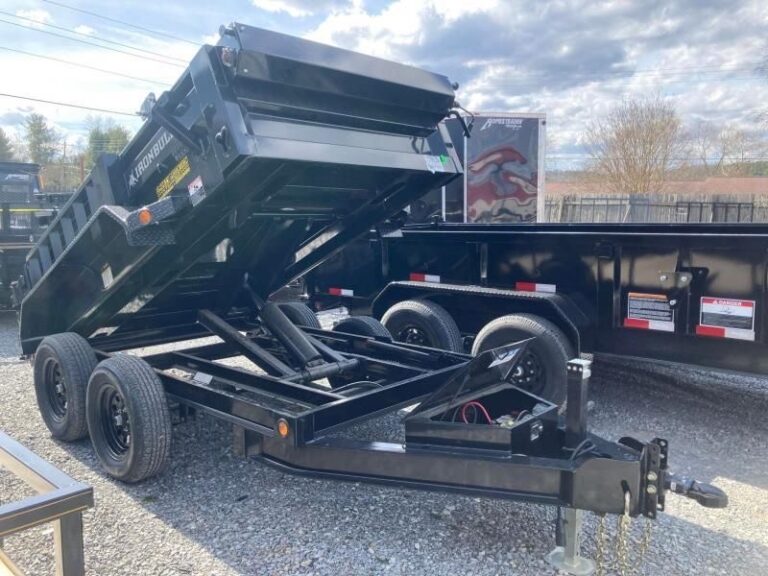
The hydraulic system is what allows a dump trailer to raise its bed.
Important components include:
- Hydraulic pump
- Hydraulic cylinder
- Reservoir
- Hoses
- Battery
- Controls
If you’re going to use the trailer frequently, the hydraulic system deserves particular attention.
Learn more with our Hydraulic Dump Trailer Buying Guide.
9. Think About Braking
A properly rated braking system becomes increasingly important as trailer weight increases.
Before purchasing, check:
- Brake type
- Number of braked axles
- Brake controller requirements
- Tow vehicle compatibility
Read our Electric Brakes vs. Surge Brakes guide.
10. Match the Trailer to Your Truck
Never choose a dump trailer based solely on its capacity.
Your pickup must also be capable of towing the loaded trailer.
Check your vehicle’s:
- Maximum towing capacity
- Payload capacity
- Hitch rating
- Tongue-weight rating
- Gross Combined Weight Rating
Your trailer’s maximum rating doesn’t override your truck’s limitations.
11. Consider a Gooseneck Configuration
For certain heavy-duty applications, you may want to consider a gooseneck dump trailer.
A gooseneck trailer connects to a hitch mounted in the pickup bed.
This is different from a conventional bumper-pull configuration.
For a detailed comparison, read our Dump Trailer vs. Gooseneck Trailer guide.
You can also read our Gooseneck Dump Trailer Buying Guide.
12. Think About What Else Your Business Hauls
A dump trailer is excellent for loose materials, but it isn’t the best solution for every type of cargo.
If you regularly transport:
- Lawn mowers
- ATVs
- Tools
- Machinery
- Building materials
you may also need a Utility Trailer.
For a direct comparison, see our Dump Trailer vs. Utility Trailer guide.
13. Consider an Enclosed Cargo Trailer
If protecting tools and equipment from weather is important, an Enclosed Cargo Trailer may complement your dump trailer.
An enclosed trailer can provide additional protection from:
- Rain
- Sun
- Road debris
- Weather exposure
This can be especially useful for contractors and landscaping companies transporting expensive equipment.
14. Consider a Deck-Over or Lowdeck Trailer
If your business transports heavy equipment, you may need a trailer specifically designed for machinery.
A Deck-Over Trailer can provide additional deck width.
A Lowdeck Trailer may be useful when loading equipment where a lower deck height is advantageous.
A dump trailer shouldn’t automatically be considered the best trailer for every heavy load.
15. Think About Daily Usage
How often you use the trailer matters.
Occasional Use
A smaller and simpler configuration may be sufficient.
Weekly Use
Durability and convenience become more important.
Daily Commercial Use
You may want to prioritize:
- Appropriate payload
- Strong frame
- Quality hydraulic components
- Proper braking
- Durable suspension
- Easy maintenance
- Convenient accessories
The goal is to choose equipment that matches your actual workload.
16. Don’t Forget Maintenance
A dump trailer requires regular inspection and maintenance.
Pay attention to:
- Tires
- Bearings
- Brakes
- Suspension
- Hydraulic hoses
- Hydraulic fluid
- Battery
- Lights
- Wiring
- Frame
- Dump bed
Construction and landscaping environments can be particularly hard on trailers because of dirt, dust, mud, and debris.
Read our Dump Trailer Maintenance Guide.
17. Useful Accessories
Depending on your work, accessories can make your trailer more convenient.
Consider:
Tarp System
Useful for covering certain loads during transportation.
Toolbox
Provides convenient storage for tools.
Spare Tire
Helpful in case of a tire failure.
Battery Charger
Can help maintain the dump trailer’s battery.
Tie-Down Equipment
Useful when securing equipment and other cargo.
Browse our Accessories category for additional trailer equipment.
18. Don’t Choose Based Only on Price
The cheapest trailer isn’t always the best value.
Instead, compare:
- Payload
- GVWR
- Axles
- Tires
- Brakes
- Hydraulic system
- Frame
- Warranty
- Intended workload
A trailer that costs slightly more but is better suited to your business can potentially provide more value over its useful life.
Dump Trailer Buying Checklist
Before purchasing, ask:
☑ What materials will I haul?
☑ How heavy are my normal loads?
☑ What is the trailer’s GVWR?
☑ What is its empty weight?
☑ What is its actual payload?
☑ What are the axle ratings?
☑ What are the tire ratings?
☑ Does it have appropriate brakes?
☑ Can my truck tow it?
☑ Do I need a single, tandem, or tri axle?
☑ Do I need a bumper-pull or gooseneck?
☑ Will I need a hydraulic dump system?
☑ Do I need a tarp or toolbox?
☑ How frequently will I use the trailer?
Quick Dump Trailer Selection Guide
Your Main Need | Consider |
|---|---|
Small residential jobs | 5×8 Dump Trailer |
General landscaping | 5×10 Dump Trailer |
Larger landscaping jobs | 6×10 Dump Trailer |
Heavy material hauling | Tandem Axle Dump Trailer |
Very demanding commercial work | Tri Axle Dump Trailer |
Heavy-duty towing setup | Gooseneck Dump Trailer |
Lawn equipment | Utility Trailer |
Heavy machinery | Deck-Over / Lowdeck |
Tools requiring weather protection | Enclosed Cargo Trailer |
Always verify the actual manufacturer’s ratings before loading or towing.
Final Thoughts
Choosing the right dump trailer for your business starts with understanding your workload.
Don’t choose based simply on trailer dimensions or the highest GVWR you can find.
Instead, match the trailer to:
Your cargo → Your typical load weight → Your required payload → Your tow vehicle → Your daily workload.
For a small landscaping business, a compact dump trailer may be all you need. A construction company handling heavy materials may require a larger tandem or tri axle configuration.
The most important thing is choosing a trailer that provides the capacity and features your business actually needs.
Explore our Dump Trailers category to find the right configuration for your hauling requirements.
Before making your decision, explore our Dump Trailer Buying Guide, 5×8 Dump Trailer Buying Guide, 5×10 Dump Trailer Buying Guide, 6×10 Dump Trailer Buying Guide, Single Axle Dump Trailer Buying Guide, and Tandem Axle Dump Trailer Buying Guide.
For other hauling requirements, explore our Utility Trailers, Deck-Over Trailers, Lowdeck Trailers, Enclosed Cargo Trailers, Horse Trailers & Stock Trailers, and Accessories.
For safe towing and loading practices, visit the NHTSA trailer safety guidelines.
