

Table of Contents
ToggleDump Trailer Weight Limits: Understanding GVWR, Payload & Safe Loading
Understanding dump trailer weight limits is essential before loading dirt, gravel, concrete, mulch, construction debris, or other heavy materials.
A trailer can have plenty of physical space left while already reaching its maximum allowable weight. That’s why knowing the difference between GVWR, payload capacity, axle ratings, tongue weight, and towing capacity is so important.
Whether you’re a contractor, landscaper, farmer, or homeowner, choosing a dump trailer based on weight ratings rather than appearance can help you select the right equipment for your work.
In this guide, we’ll explain how dump trailer weight limits work and what you should check before purchasing or loading a trailer.
What Is Dump Trailer GVWR?
GVWR stands for Gross Vehicle Weight Rating.
For a trailer, GVWR represents the maximum allowable combined weight of:
Trailer + cargo
For example, if a dump trailer has a 14,000-pound GVWR, the combined weight of the empty trailer and everything loaded onto it must not exceed that rating.
That does not mean the trailer can carry 14,000 pounds of cargo.
You must subtract the trailer’s empty weight to determine its approximate maximum payload.
What Is Payload Capacity?
Payload is the amount of cargo the trailer can carry.
A simplified calculation is:
Payload = GVWR − Empty Trailer Weight
For example:
- GVWR: 14,000 lbs
- Empty trailer weight: 4,000 lbs
- Approximate payload: 10,000 lbs
Actual allowable loading can depend on additional ratings and restrictions, so always follow the trailer manufacturer’s specifications.
For more information, see our Dump Trailer Capacity Guide.
Why Dump Trailer Weight Limits Matter
Overloading a dump trailer can place excessive stress on:
- Axles
- Tires
- Wheels
- Bearings
- Suspension
- Brakes
- Frame
- Tow vehicle
It can also affect handling and braking.
The fact that material fits inside the dump bed doesn’t mean the trailer can legally or safely carry it.
Common Dump Trailer GVWR Ratings
Dump trailers are available in different weight classes and configurations.
You may encounter trailers designed around ratings such as:
- 7,000 lbs
- 10,000 lbs
- 12,000 lbs
- 14,000 lbs
- Higher-capacity configurations
The correct choice depends on the manufacturer’s specifications and your intended application.
A larger GVWR isn’t automatically better if your tow vehicle isn’t capable of handling it.
How Much Can a 5×8 Dump Trailer Carry?
A 5×8 dump trailer can have different weight ratings depending on the specific model.
That’s why size alone cannot determine payload capacity.
Two 5×8 trailers can have different:
- GVWRs
- Axle ratings
- Empty weights
- Tire ratings
- Brake configurations
Before loading one, check its manufacturer’s data plate and documentation.
See our 5×8 Dump Trailer Buying Guide.
How Much Can a 5×10 Dump Trailer Carry?
The same principle applies to a 5×10 dump trailer.
Its actual payload depends on the specific trailer’s:
- GVWR
- Empty weight
- Axle capacity
- Tire capacity
- Suspension
- Frame
- Other manufacturer specifications
Read our 5×10 Dump Trailer Buying Guide for more information.
How Much Can a 6×10 Dump Trailer Carry?
A 6×10 dump trailer generally provides more physical space than smaller models, but the available payload still depends on its ratings.
Don’t assume a larger bed automatically means a higher payload.
Before purchasing, compare:
Bed size + GVWR + empty weight + payload + axle ratings
Our 6×10 Dump Trailer Buying Guide covers this configuration in greater detail.
Single Axle vs. Tandem Axle Weight Capacity
Single Axle Dump Trailer
A single axle configuration may be suitable for lighter hauling applications.
See our Single Axle Dump Trailer Buying Guide.
Tandem Axle Dump Trailer
Tandem axle configurations are commonly used for heavier applications.
They can provide greater rated capacity depending on the specific trailer.
See our Tandem Axle Dump Trailer Buying Guide.
However, never determine capacity simply by counting axles. Always check the manufacturer’s actual ratings.
What About Tri Axle Dump Trailers?
Tri axle dump trailers are designed for applications requiring greater capacity and load support, depending on their specific specifications.
They may be considered for:
- Heavy construction materials
- Commercial hauling
- Excavation
- Demolition
- Large landscaping operations
Read our Tri Axle Dump Trailer Buying Guide.
Again, the number of axles alone does not determine the legal or safe payload.
Material Weight Makes a Huge Difference
One of the biggest mistakes people make is thinking:
“If it fits, I can haul it.”
That’s not how trailer capacity works.
Different materials have dramatically different weights.
Mulch
Generally lighter by volume.
Topsoil
Can become considerably heavier when wet.
Gravel
Dense and capable of reaching a trailer’s weight limit quickly.
Sand
Also extremely heavy by volume.
Concrete
Very dense and can exceed payload limits surprisingly quickly.
Yard Debris
Weight varies significantly depending on the material and moisture.
Always consider the actual weight of the load.
Why Wet Materials Are Important
Moisture can significantly increase the weight of certain materials.
For example, a load of soil that has absorbed substantial water can weigh considerably more than dry soil occupying the same amount of space.
The same principle applies to certain landscaping and construction materials.
If you’re regularly hauling materials that change weight depending on moisture, leave an appropriate margin rather than consistently loading to the absolute maximum.
Axle Ratings
A trailer’s axles have their own weight ratings.
For example, a trailer may have:
- One axle
- Two axles
- Three axles
But you need to consider the rating of each axle as well as the combined trailer specifications.
The axles, tires, wheels, suspension, and frame must all be appropriate for the intended load.
Tire Weight Ratings
Your tires are another critical part of the load-carrying system.
Check the tire sidewall and trailer specifications for:
- Maximum load
- Recommended inflation
- Tire size
- Load range
Never assume that having several tires automatically means unlimited carrying capacity.
The entire trailer system must remain within its rated limits.
Brakes and Heavy Loads
A heavier trailer requires an appropriately rated braking system.
Before purchasing or loading your trailer, check:
- Brake configuration
- Number of braked axles
- Brake controller requirements
- Tow vehicle compatibility
Read our Electric Brakes vs. Surge Brakes guide for more information.
Tongue Weight
Tongue weight is the downward force the trailer places on the tow vehicle’s hitch.
Proper tongue weight is important for stable towing.
Too much or too little tongue weight can negatively affect handling.
That’s why distributing cargo properly inside the dump bed is important.
Follow the trailer manufacturer’s loading recommendations and avoid placing excessive weight at the front or rear of the trailer.
Proper Load Distribution
A dump trailer should not simply be filled without considering where the weight is concentrated.
Try to distribute cargo according to the trailer manufacturer’s recommendations.
Avoid:
- Excessive weight at the rear
- Excessive weight at the front
- Concentrating extremely heavy material in one area
- Exceeding axle ratings
Proper distribution helps keep the trailer balanced and reduces unnecessary stress on components.
Dump Trailer Weight vs. Tow Vehicle Capacity
Your trailer may have a high GVWR, but that doesn’t mean your pickup can tow it at maximum capacity.
You need to consider both:
Trailer Ratings
- GVWR
- Payload
- Axle ratings
- Tire ratings
Vehicle Ratings
- Maximum towing capacity
- Payload capacity
- Hitch rating
- Gross Combined Weight Rating
The lower applicable limitation becomes important when determining what you can safely tow.
Gooseneck Dump Trailer Weight Considerations
Gooseneck dump trailers can be designed for heavy-duty applications.
A gooseneck connection places the hitch inside the pickup’s bed rather than at the rear bumper.
If you’re considering this configuration, see our Gooseneck Dump Trailer Buying Guide.
The same fundamental rule applies:
The trailer’s ratings and the tow vehicle’s ratings must be compatible.
Dump Trailer Weight Limits for Construction
Construction contractors frequently haul dense materials.
For example:
- Gravel
- Concrete
- Dirt
- Sand
- Demolition debris
These materials can reach weight limits quickly.
If you work in construction, read our Best Dump Trailer for Construction guide for additional buying considerations.
Dump Trailer Weight Limits for Landscaping
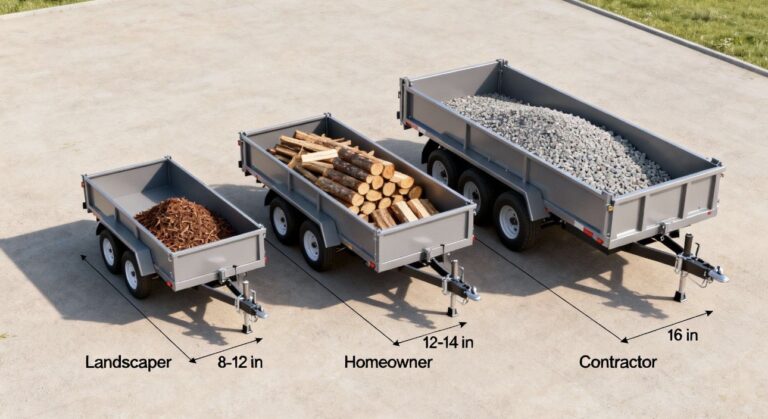
Landscapers commonly transport:
- Mulch
- Topsoil
- Gravel
- Stone
- Yard debris
A smaller trailer may be appropriate for residential landscaping, while larger commercial operations may require a higher-capacity configuration.
See our Best Dump Trailer for Landscaping guide.
How to Check Your Trailer’s Weight Rating
Before loading your dump trailer:
Step 1: Find the Manufacturer’s Data Plate
Look for the trailer’s rating information.
Step 2: Check the GVWR
Determine the maximum allowable gross trailer weight.
Step 3: Check the Empty Weight
Find the trailer’s unloaded weight.
Step 4: Determine Payload
Subtract the empty trailer weight from the GVWR.
Step 5: Check Axle and Tire Ratings
Make sure these components support the intended load.
Step 6: Check Your Tow Vehicle
Verify that your truck is rated for the loaded trailer.
Should You Load to the Maximum?
It’s generally better to avoid treating the maximum rating as a target for every trip.
Real-world conditions vary, and materials aren’t always uniform in weight.
Leaving an appropriate margin can help accommodate differences in material density and moisture.
Always follow the manufacturer’s loading instructions and applicable regulations.
Dump Trailer Weight Limit Quick Reference
Factor | Why It Matters |
|---|---|
GVWR | Maximum combined trailer + cargo weight |
Empty Weight | Weight of the trailer itself |
Payload | Approximate cargo capacity |
Axle Rating | Supports trailer and cargo |
Tire Rating | Supports the load |
Brake Rating | Helps control heavier loads |
Tongue Weight | Affects towing stability |
Tow Rating | Determines vehicle capability |
Load Distribution | Helps maintain balance |
Final Thoughts
Understanding dump trailer weight limits is essential for choosing and operating the right trailer.
Don’t choose a trailer based solely on bed dimensions.
Instead, evaluate:
GVWR + payload + axle ratings + tire ratings + brakes + tow vehicle capacity.
Also consider what you’re hauling. A trailer that works well for mulch may have completely different practical limits when loaded with gravel, concrete, or wet soil.
For contractors and landscapers, selecting the right capacity can make daily hauling more efficient while helping prevent unnecessary strain on the trailer and tow vehicle.
Explore our Dump Trailers category to compare available options.
Before making your decision, explore our Dump Trailer Buying Guide, 5×8 Dump Trailer Buying Guide, 5×10 Dump Trailer Buying Guide, 6×10 Dump Trailer Buying Guide, Single Axle Dump Trailer Buying Guide, and Tandem Axle Dump Trailer Buying Guide.
For other hauling requirements, explore our Utility Trailers, Deck-Over Trailers, Lowdeck Trailers, Enclosed Cargo Trailers, Horse Trailers & Stock Trailers, and Accessories.
For safe towing and loading practices, visit the NHTSA trailer safety guidelines.
