

Table of Contents
ToggleHow Much Weight Can a Deck-Over Trailer Carry? Understanding Payload, GVWR & Capacity
If you’re considering a deck-over trailer for heavy equipment, machinery, vehicles, or construction materials, one of the first questions you need to answer is:
How much weight can a deck-over trailer carry?
The answer isn’t the same for every deck-over trailer. Capacity depends on the trailer’s GVWR, payload rating, axle configuration, tires, frame, suspension, brakes, and empty trailer weight.
This article is part of our Deck-Over Trailer Buying Guide: How to Choose the Best Trailer for Heavy Equipment and Wide Loads, the main guide for choosing the right deck-over trailer for your hauling requirements.
It’s also useful to understand the basic design first. Our What Is a Deck-Over Trailer? Everything You Need to Know explains how the deck-over configuration works and why its full-width deck is useful for wide and heavy loads.
For buyers ready to compare available options, visit our Deck-Over Trailers category.
Deck Size Does Not Determine Weight Capacity
One of the most common mistakes when shopping for a trailer is assuming that a longer or wider deck automatically means a higher carrying capacity.
It doesn’t.
A 24-foot trailer, for example, isn’t automatically capable of carrying more weight than a shorter trailer.
Capacity depends on the trailer’s complete construction and specifications.
Important factors include:
- GVWR
- Payload capacity
- Axle ratings
- Number of axles
- Tire ratings
- Suspension
- Frame construction
- Braking system
- Empty trailer weight
That’s why you should always check the manufacturer’s specifications for the specific trailer you are considering.
What Is Payload Capacity?
Payload capacity is the amount of cargo the trailer is designed to carry.
A simple way to understand the relationship is:
Payload Capacity ≈ GVWR − Empty Trailer Weight
For example, if a trailer has a GVWR of 14,000 pounds and weighs 4,000 pounds empty, the theoretical remaining capacity would be approximately 10,000 pounds.
However, you should always use the actual manufacturer’s specifications rather than relying solely on a simple calculation.
Example
Specification | Example |
|---|---|
GVWR | 14,000 lbs |
Empty trailer weight | 4,000 lbs |
Approximate payload | 10,000 lbs |
Cargo weight | 8,000 lbs |
Remaining theoretical capacity | 2,000 lbs |
The example above is for illustration only. The actual ratings on your trailer should always be verified before loading.
What Is GVWR?
GVWR stands for Gross Vehicle Weight Rating.
It represents the maximum allowable total weight of the trailer and its cargo.
This distinction is extremely important.
GVWR is not the amount of cargo you can put on the trailer.
If a trailer has a 14,000-lb GVWR, that doesn’t mean you can load 14,000 pounds of equipment onto it.
You must account for the trailer’s own weight.
Think of it this way:
Trailer + Cargo = Loaded Trailer Weight
That combined weight must remain within the trailer’s rated GVWR.
Why Axle Capacity Matters
The axles are among the most important components affecting a trailer’s weight capability.
A deck-over trailer may have:
- Single axle
- Tandem axles
- Multiple-axle configurations
The axle configuration needs to be appropriate for the trailer’s intended load.
However, you should not simply add axle ratings together and assume that number is automatically the trailer’s legal or safe carrying capacity.
The complete trailer system—including the frame, suspension, tires, wheels, brakes, and GVWR—must be considered.
Tires Are Part of the Capacity Equation
Tires are another critical component.
Every trailer tire has a specified load rating.
When carrying heavy equipment, the tires need to be appropriate for the trailer and its intended load.
Before purchasing, check:
- Tire size
- Load rating
- Number of tires
- Manufacturer specifications
- Recommended inflation pressure
A trailer with strong axles still needs appropriately rated tires.
How Much Weight Do You Actually Need to Carry?
Before selecting a deck-over trailer, determine the weight of the loads you expect to transport.
Don’t only consider your smallest or average load.
Think about the heaviest load you regularly expect to haul.
For example:
Typical Load | What to Consider |
|---|---|
Small equipment | Lower capacity may be sufficient |
Compact construction equipment | Consider equipment weight plus attachments |
Agricultural machinery | Account for implements and accessories |
Heavy machinery | Higher capacity may be necessary |
Multiple pieces of equipment | Calculate the combined weight |
This approach can prevent you from purchasing a trailer that becomes inadequate when your workload increases.
Don’t Forget Attachments
Equipment weight isn’t always limited to the machine itself.
Attachments can add significant weight.
Examples include:
- Buckets
- Forks
- Blades
- Implements
- Tool attachments
- Additional equipment
If you regularly transport equipment with attachments, include those items when calculating your expected load.
The goal is to determine the complete transport weight, not just the manufacturer’s base equipment weight.
How Deck-Over Trailers Handle Wide Loads
Weight isn’t the only reason buyers choose a deck-over trailer.
The design is also particularly useful when width matters.
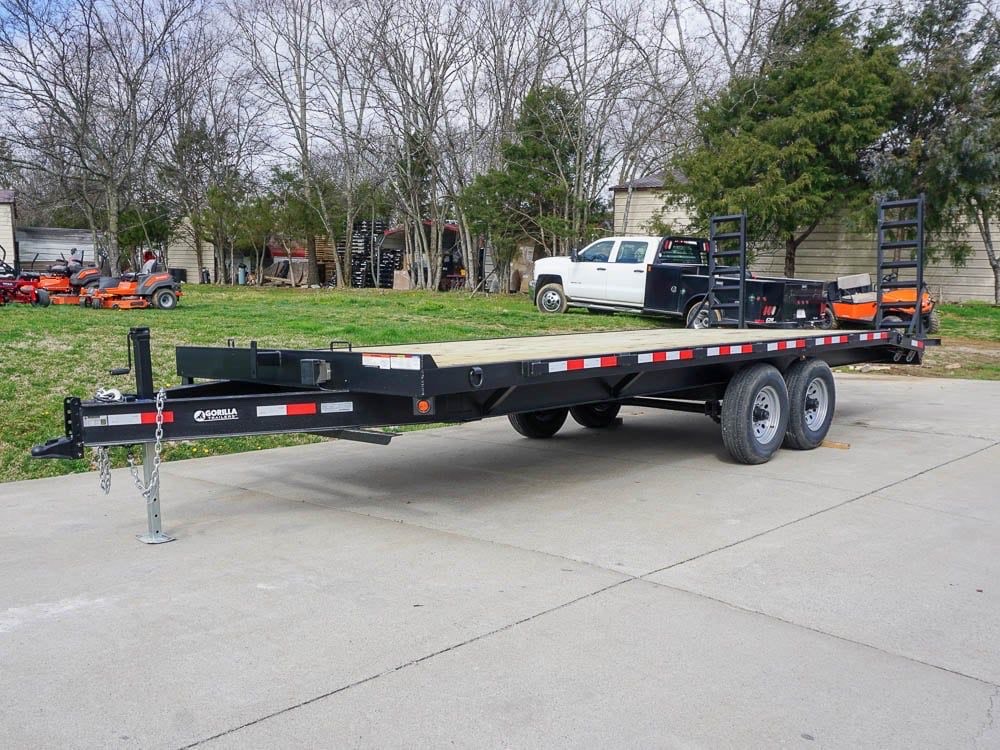
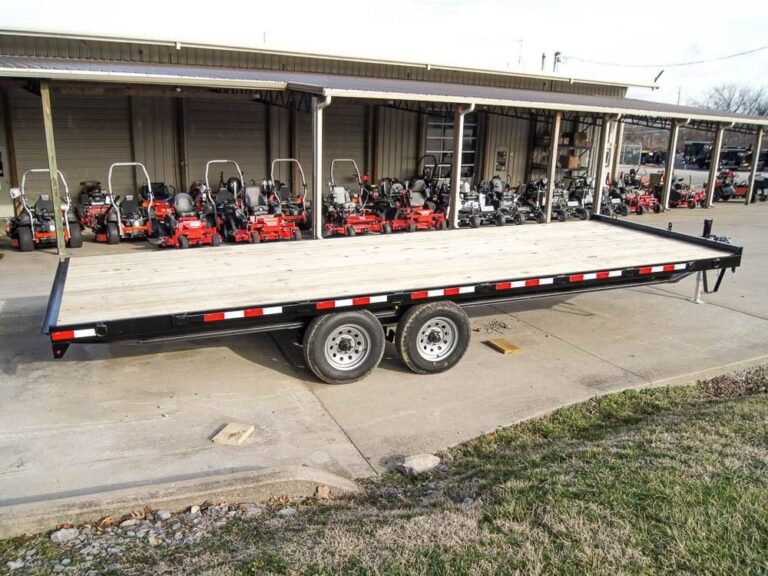
Because the deck sits above the wheels, the trailer can provide a full-width loading platform without wheel wells occupying valuable deck space.
That makes the design useful for:
- Wide machinery
- Construction equipment
- Agricultural equipment
- Large materials
- Industrial equipment
So when choosing a deck-over trailer, you need to solve two different problems:
1. Does the cargo fit on the deck?
This concerns length and width.
2. Can the trailer carry the cargo?
This concerns weight and capacity.
Both are essential.
Why Buying More Capacity Can Make Sense
If your current equipment weighs close to the maximum capacity of a trailer, you may want to consider a higher-capacity configuration.
This can provide greater flexibility for:
- Heavier equipment
- Attachments
- Future purchases
- Additional cargo
- Changing business requirements
However, buying the highest-capacity trailer available isn’t automatically the best decision.
A larger, heavier trailer may require a more capable tow vehicle and can increase purchase, operating, and storage considerations.
The objective is to choose appropriate capacity, not simply maximum capacity.
Match the Trailer to Your Tow Vehicle
The trailer’s capacity is only one side of the equation.
Your towing vehicle also needs to be capable of handling the loaded trailer.
Before purchasing, consider:
- Vehicle towing capacity
- Hitch or gooseneck configuration
- Loaded trailer weight
- Tongue weight
- Vehicle payload capacity
- Braking requirements
For heavier deck-over trailers, the towing vehicle becomes especially important.
A trailer can be perfectly suited to your equipment but still be inappropriate if your truck isn’t rated for the combination.
How to Calculate Your Required Trailer Capacity
A simple process can help you determine the capacity you should look for.
Step 1: Identify Your Heaviest Regular Load
Start with the equipment you expect to transport most often.
Step 2: Determine Its Actual Weight
Use reliable manufacturer specifications or weigh the equipment when possible.
Step 3: Add Attachments
Include buckets, implements, tools, and other equipment that will travel with the load.
Step 4: Consider Additional Cargo
If you regularly carry additional materials or equipment, include those as well.
Step 5: Compare With Trailer Payload
Make sure the complete load is appropriate for the trailer’s rated payload.
Step 6: Check the GVWR
Verify that the loaded trailer remains within its GVWR.
Step 7: Check Your Tow Vehicle
Finally, make sure your truck is appropriately rated for the loaded trailer.
Example: Choosing Capacity for Construction Equipment
Imagine a contractor regularly transports:
- Construction machine: 7,500 lbs
- Attachment: 500 lbs
- Tools and additional equipment: 500 lbs
The total cargo would be approximately:
8,500 lbs
The buyer should then look for a trailer whose rated payload is appropriate for that load, while also considering the trailer’s own weight and GVWR.
The tow vehicle must also be capable of safely towing the resulting loaded combination.
This is why simply asking, “What size trailer do I need?” isn’t enough.
You need to ask:
What will I haul, and how much will the complete load weigh?
Capacity and Trailer Size Should Be Considered Together
Trailer dimensions and capacity work together.
You need enough deck space for the equipment and enough capacity for its weight.
Requirement | What You Need to Determine |
|---|---|
Length | How long is the equipment? |
Width | How wide is the equipment? |
Weight | How heavy is the complete load? |
Attachments | What additional equipment travels with it? |
Deck space | How much room is needed for positioning? |
Payload | Can the trailer carry the cargo? |
GVWR | Does the loaded trailer remain within its rating? |
Tow vehicle | Can the truck handle the loaded trailer? |
This is why trailer shopping should always begin with the actual hauling requirements.
Common Mistakes When Choosing Trailer Capacity
Choosing Based on Deck Size Alone
A large deck doesn’t automatically mean a high payload rating.
Ignoring the Weight of the Trailer
Remember that the trailer itself contributes to the loaded weight.
Forgetting Attachments
Equipment attachments can add hundreds or thousands of pounds depending on the application.
Ignoring the Tow Vehicle
The truck must be capable of handling the loaded trailer.
Choosing the Absolute Minimum Capacity
A trailer that barely handles today’s load may become inadequate as your needs grow.
Assuming All Deck-Over Trailers Have the Same Capacity
Deck-over describes the trailer’s design, not one universal weight rating.
Different models can have very different capacities.
Deck-Over Trailer Capacity vs Other Trailer Types
The right capacity depends on the type of hauling you are doing.
For general-purpose and lighter hauling, Utility Trailers may be more appropriate for your needs.
For applications requiring a lower deck and easier loading height, Lowdeck Trailers may be worth considering.
For material hauling where the ability to raise and unload the bed is important, Dump Trailers provide a completely different configuration.
The important thing is to select the trailer category based on the job first, then select the appropriate size and capacity within that category.
What Capacity Should You Choose?
There isn’t one universal capacity that is right for every deck-over trailer buyer.
Instead, work backward from your actual load.
Light-duty hauling
Focus on a trailer that comfortably handles your equipment without unnecessarily adding size and weight.
Regular commercial hauling
Consider your typical workload and whether your equipment requirements are likely to increase.
Heavy equipment hauling
Pay close attention to payload, GVWR, axle configuration, tires, brakes, and the towing vehicle.
Wide and heavy loads
The deck-over configuration can provide the usable width you need, but the trailer still needs adequate weight capacity for the cargo.
Final Thoughts
So, how much weight can a deck-over trailer carry?
There isn’t one answer for every deck-over trailer. Capacity depends on the individual trailer’s GVWR, payload rating, axles, tires, suspension, frame, brakes, and empty weight.
The smartest way to choose is to start with the equipment you actually plan to haul.
Measure it.
Weigh it.
Include the attachments.
Consider future requirements.
Then choose a trailer with specifications appropriate for the complete load and make sure your towing vehicle can handle the combination.
For the complete buying process, return to our Deck-Over Trailer Buying Guide: How to Choose the Best Trailer for Heavy Equipment and Wide Loads.
If you’re ready to compare available options, explore our Deck-Over Trailers category.
For other hauling requirements, explore our Utility Trailers, Deck-Over Trailers, Lowdeck Trailers, Enclosed Cargo Trailers, Horse Trailers & Stock Trailers, and Accessories.
For safe towing and loading practices, visit the NHTSA trailer safety guidelines.
