

Table of Contents
ToggleDeck-Over Trailer Axles Explained: Types, Ratings & How to Choose
When choosing a deck-over trailer, it’s easy to focus on the deck length, width, ramps, and overall appearance. However, one of the most important components underneath the trailer is the axle system.
Trailer axles support the trailer through the suspension and work together with the wheels, tires, brakes, and frame to handle the weight of your cargo.
For anyone hauling construction equipment, tractors, machinery, vehicles, or other substantial loads, understanding trailer axles is essential.
If you’re beginning your research, start with our Deck-Over Trailer Buying Guide: How to Choose the Best Trailer for Heavy Equipment and Wide Loads. It covers the major factors to consider before buying.
This guide focuses specifically on deck-over trailer axles, including axle ratings, single and tandem configurations, wheel setups, brakes, and how to match the axle system to your hauling requirements.
What Is a Trailer Axle?
A trailer axle is a structural component that connects the wheels and supports the trailer through its suspension system.
On a deck-over trailer, the axle system works together with:
- Wheels
- Tires
- Suspension
- Brakes
- Hubs
- Bearings
- Frame
- Coupler
The axle system must be properly matched to the trailer’s intended load.
A trailer can have a large deck and still have limited payload capacity if its axles, tires, frame, or other components are not rated for heavier loads.
Why Are Axles Important on a Deck-Over Trailer?
Deck-over trailers are frequently chosen for equipment and wide-load applications, so the axle configuration deserves careful attention.
The axle system affects several important aspects of the trailer, including:
- Load-supporting capability
- Wheel configuration
- Braking configuration
- Suspension design
- Weight distribution
- Overall trailer capacity
However, axle rating should not be confused with payload capacity.
A trailer’s allowable load depends on its complete specification.
Understanding Trailer Axle Ratings
One of the most important numbers to understand is the axle weight rating.
For example, imagine a trailer equipped with two axles, each rated at 7,000 pounds.
A simplified calculation would be:
7,000 lbs × 2 axles = 14,000 lbs combined axle rating
But that does not automatically mean the trailer can carry 14,000 pounds of cargo.
The trailer itself has weight.
For example:
- GVWR: 14,000 lbs
- Empty trailer weight: 4,000 lbs
Approximate theoretical payload:
14,000 − 4,000 = 10,000 lbs
The actual allowable capacity must be determined from the manufacturer’s specifications and all applicable ratings.
Axle Rating vs GVWR vs Payload
These terms are often confused when comparing trailers.
Specification | Meaning |
|---|---|
Axle Rating | Rated capacity of an individual axle |
GVWR | Maximum allowable loaded weight of the complete trailer |
Empty Weight | Weight of the trailer without cargo |
Payload | Cargo weight that can be carried within the trailer’s ratings |
GAWR | Maximum allowable weight assigned to an axle or axle group |
A useful starting calculation is:
Payload = GVWR − Empty Trailer Weight
However, other components can impose additional limitations. Tires, suspension, frame, brakes, wheels, and coupler ratings all need to be appropriate for the intended load.
Single-Axle Deck-Over Trailers
A single-axle deck-over trailer uses one axle assembly.
This configuration can work well when the required cargo weight falls comfortably within the trailer’s rated capacity.
Potential advantages include:
- Simpler configuration
- Fewer tires
- Fewer wheels and related components
- Potentially easier maneuverability
- Lower trailer weight in some designs
Single-axle trailers are often associated with lighter-duty applications, but the actual specifications matter more than the axle count alone.
Always check the trailer’s GVWR and payload before deciding whether it is suitable for your equipment.
Tandem-Axle Deck-Over Trailers
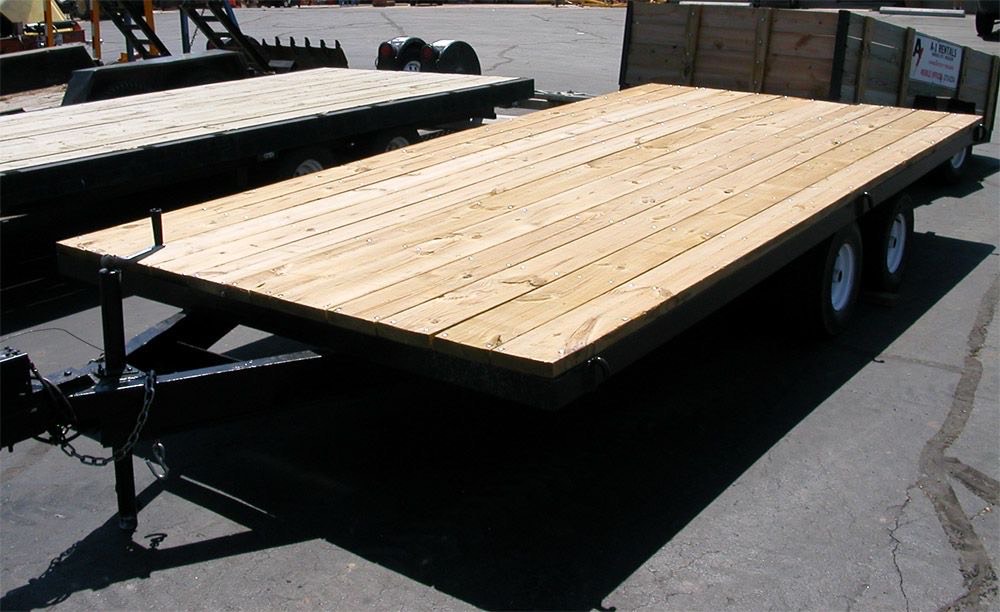
A tandem-axle trailer has two axle assemblies.
This is a common configuration for deck-over trailers used for more substantial hauling applications.
Depending on the design and ratings, tandem axles can provide:
- Greater load-supporting capability
- Additional tire support
- Additional braking capability when appropriately equipped
- A configuration suitable for many equipment-hauling applications
Tandem-axle deck-over trailers may be used for:
- Skid steers
- Compact tractors
- Construction equipment
- Vehicles
- Landscaping machinery
- Building materials
The exact capacity varies from one trailer to another.
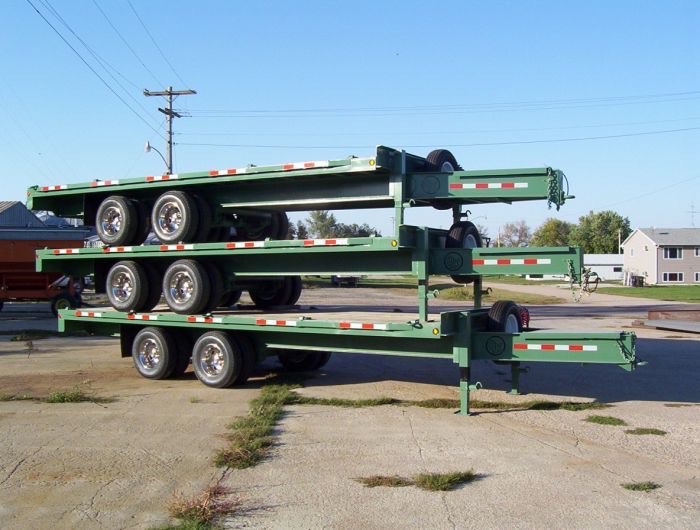
Tri-Axle Deck-Over Trailers
A tri-axle trailer uses three axle assemblies.
This configuration can be designed for applications requiring additional axle capacity and load distribution.
Tri-axle deck-over trailers may be considered for:
- Heavy equipment
- Commercial hauling
- Large machinery
- Construction loads
- Other demanding applications
However, adding another axle does not automatically mean the trailer can be loaded beyond its GVWR.
The manufacturer’s GVWR remains a critical limitation.
Single vs Tandem vs Tri-Axle
Here’s a simple comparison:
Configuration | Axles | General Application |
|---|---|---|
Single axle | 1 | Lighter hauling applications |
Tandem axle | 2 | Equipment and heavier general hauling |
Tri-axle | 3 | Higher-capacity or demanding applications |
These are general descriptions, not universal capacity classifications.
When comparing actual trailers, always check:
- GVWR
- GAWR
- Payload
- Axle ratings
- Tire ratings
- Brake specifications
Single Wheel vs Dual Wheel Axles
Axle count isn’t the only configuration you need to understand.
A deck-over trailer can also use different wheel arrangements.
Single-Wheel Configuration
There is one tire on each side of an axle.
Dual-Wheel Configuration
There are two tires on each side of an axle.
The configuration can affect:
- Tire count
- Wheel count
- Load-supporting capability
- Maintenance
- Intended application
For a detailed comparison, see our Single Wheel vs Dual Wheel Deck-Over Trailers article.
The important point is that more tires don’t automatically mean more payload. The complete trailer must be designed and rated accordingly.
Does More Axles Always Mean More Capacity?
No.
This is one of the most important misconceptions to avoid.
A trailer with three axles isn’t automatically capable of carrying a particular amount of weight simply because it has more axles.
Capacity can be limited by:
- Axles
- Tires
- Wheels
- Frame
- Suspension
- Brakes
- Coupler
- GVWR
The complete trailer specification determines how much weight can legally and safely be carried.
Therefore, don’t choose a trailer simply because it has more axles.
Instead, compare the actual ratings.
Trailer Brakes and Axles
Braking is another important consideration when evaluating axle configurations.
Depending on the trailer design, axles can be equipped with electric brakes or other braking systems.
A trailer braking system may include:
- Brake assemblies
- Brake drums
- Hubs
- Wiring
- Brake-controller compatibility
When comparing trailers, check:
- Which axles have brakes?
- What type of brakes are installed?
- What does the tow vehicle require?
- What regulations apply to the trailer and intended use?
Never assume every axle configuration has the same braking setup.
How Axles Affect Weight Distribution
Axle placement is important because the trailer needs to distribute its loaded weight appropriately.
When cargo is loaded onto a deck-over trailer, its position can affect:
- Tongue weight
- Axle loading
- Trailer handling
- Stability
Heavy equipment should not simply be placed wherever there is available deck space.
Cargo should be positioned and secured according to the trailer manufacturer’s recommendations.
This is especially important with large machinery because a heavy machine can concentrate substantial weight over a relatively small portion of the deck.
Choosing the Right Axle Configuration
Start with your actual hauling requirements.
Ask yourself:
What is the heaviest item I will haul?
This establishes the minimum capacity requirement.
How wide is the equipment?
A deck-over trailer provides a wide loading surface, but the axle system still needs to support the intended load.
How frequently will I use the trailer?
Occasional hauling and daily commercial hauling may lead to different requirements.
Will I transport multiple pieces of equipment?
If you regularly carry several machines, the combined loaded weight becomes especially important.
What can my truck tow?
The tow vehicle must be compatible with the loaded trailer.
Axle Configuration for Common Applications
Application | What to Consider |
|---|---|
Small equipment | Single axle capacity and trailer weight |
Landscaping equipment | Payload, deck space, and towing requirements |
Skid steer | Weight, width, GVWR, axles, and ramps |
Compact tractor | Equipment weight and dimensions |
Construction machinery | GVWR, payload, axles, brakes, and tow vehicle |
Commercial hauling | Capacity, durability, brakes, and workload |
Heavy equipment | Complete trailer specification and legal ratings |
The exact trailer should always be selected based on its documented specifications.
How Trailer Size and Axles Work Together
Trailer dimensions and axle capacity need to work together.
For example, you might need a 24-foot deck because of the length of your equipment. But that doesn’t automatically determine the number or rating of axles required.
Instead, evaluate:
Cargo dimensions + cargo weight + trailer weight + GVWR + axle ratings + tow vehicle
That’s why our What Size Deck-Over Trailer Do You Need? A Complete Guide article works well alongside this guide.
The two articles answer different questions:
- Trailer size: Will my cargo fit?
- Axle and capacity: Can the trailer support the loaded weight within its ratings?
You need both answers before purchasing.
Common Deck-Over Trailer Axle Mistakes
1. Choosing Based Only on Axle Count
More axles don’t automatically mean more usable payload.
Always check the actual ratings.
2. Ignoring Empty Trailer Weight
The trailer’s own weight reduces the cargo weight available under the GVWR.
3. Forgetting Tire Ratings
The tires must be properly rated for the trailer configuration.
4. Ignoring the Tow Vehicle
The trailer may have sufficient capacity while the tow vehicle does not.
5. Exceeding Axle Ratings
Never exceed the manufacturer’s axle ratings.
6. Poor Weight Distribution
Even a properly rated trailer can handle poorly if cargo is positioned incorrectly.
What Should You Check Before Buying?
Use this checklist when comparing deck-over trailer axles:
☐ Number of axles
☐ Axle rating
☐ GVWR
☐ GAWR
☐ Empty trailer weight
☐ Payload capacity
☐ Tire load rating
☐ Wheel configuration
☐ Brake configuration
☐ Suspension type
☐ Coupler rating
☐ Tow vehicle capacity
☐ Manufacturer specifications
This provides a much more accurate picture than simply counting the axles.
Do You Need a Single, Tandem, or Tri-Axle Trailer?
There isn’t one axle configuration that works for every buyer.
A single-axle trailer may work when your loads fall within the trailer’s rated capacity.
A tandem-axle trailer may be appropriate for many equipment and commercial hauling applications.
A tri-axle trailer may be appropriate when the trailer is specifically engineered and rated for demanding loads requiring three axles.
The important thing is to match the complete trailer specification to your cargo and towing requirements.
Shop Deck-Over Trailers
Once you’ve determined your required dimensions and capacity, you can compare available models in the Deck-Over Trailers category.
Pay particular attention to:
- Axle configuration
- Axle rating
- GVWR
- Payload
- Tire rating
- Brakes
- Deck dimensions
- Empty weight
- Suspension
- Coupler
- Ramp configuration
If you’re comparing a deck-over with a lower-deck configuration, Lowdeck Trailers can also be considered when loading height is an important factor.
Frequently Asked Questions
How many axles does a deck-over trailer have?
Deck-over trailers can be built with single, tandem, or tri-axle configurations. The appropriate setup depends on the trailer’s intended application and ratings.
Is a tandem axle better than a single axle?
They serve different applications. The appropriate choice depends on cargo weight, trailer specifications, tow vehicle capacity, and intended use.
Does a dual-wheel trailer have more capacity?
A dual-wheel trailer may be built in higher-capacity configurations, but tire count alone doesn’t determine capacity. Always check the manufacturer’s specifications.
Does a longer trailer need more axles?
Not necessarily. Trailer length alone doesn’t determine axle count. Capacity, design, weight distribution, and intended use all matter.
Can I exceed the axle rating if the trailer’s GVWR is higher?
No. You should not exceed the applicable axle, tire, GVWR, or other component ratings.
Should both axles have brakes?
Brake configuration varies between trailers. Check the manufacturer’s specifications and applicable requirements for the trailer you’re considering.
Final Thoughts
The axle system underneath a deck-over trailer is one of the most important parts of the trailer’s overall design.
When comparing trailers, don’t simply look at whether a model has one, two, or three axles. Look at the complete system: axle ratings, GVWR, payload, tires, brakes, suspension, frame, and tow vehicle compatibility.
Your cargo should determine the requirements.
A single-axle trailer may be appropriate for lighter applications when its ratings accommodate the load. A tandem-axle configuration can be suitable for many equipment-hauling applications, while a properly specified tri-axle trailer may be used for more demanding loads.
Most importantly, axle capacity is not the same thing as payload capacity. The trailer’s own weight and the ratings of its other components must also be considered.
Before choosing a model, use What Size Deck-Over Trailer Do You Need? A Complete Guide to determine the appropriate dimensions, then use this axle guide to understand the supporting capacity and configuration.
When you’re ready to compare actual models, visit Deck-Over Trailers and review each trailer’s specifications carefully.
The right axle configuration is the one that matches your cargo, trailer ratings, towing vehicle, and intended workload—not simply the one with the most axles.
For other hauling requirements, explore our Utility Trailers, Deck-Over Trailers, Lowdeck Trailers, Enclosed Cargo Trailers, Horse Trailers & Stock Trailers, and Accessories.
For safe towing and loading practices, visit the NHTSA trailer safety guidelines.
