

Table of Contents
Toggle5×8 Enclosed Cargo Trailer Buying Guide: How to Choose the Right Compact Trailer
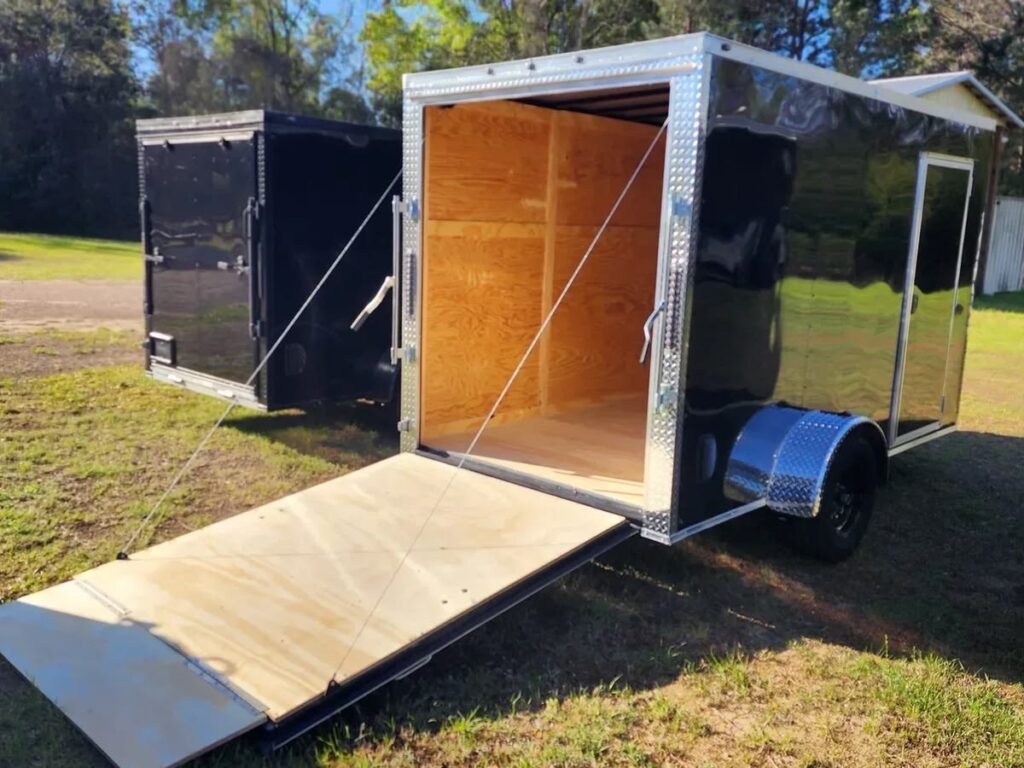
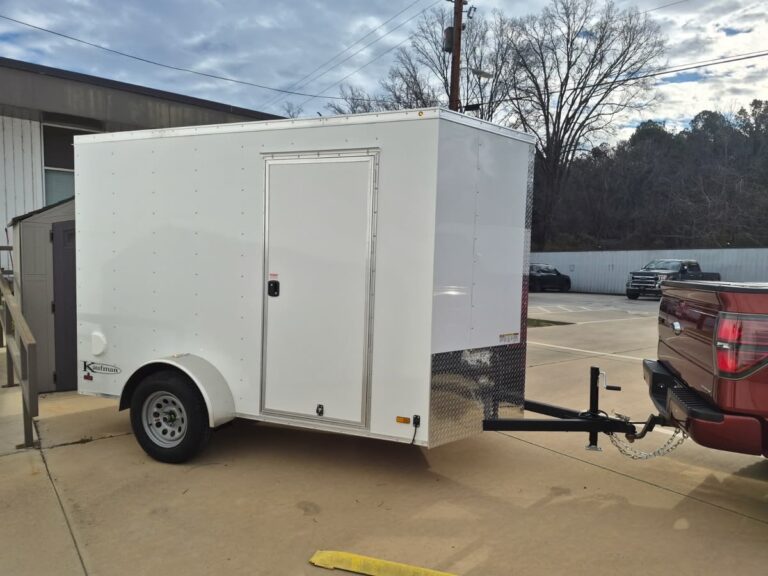
A 5×8 enclosed cargo trailer is one of the more compact enclosed trailer configurations available to buyers who need protected cargo space without moving up to a larger trailer.
Its relatively compact footprint can make it useful for transporting tools, supplies, small equipment, recreational gear, business inventory, and other cargo that doesn’t require a large interior.
But choosing a 5×8 trailer isn’t simply about whether your cargo can physically fit inside.
You also need to consider:
- Cargo dimensions
- Cargo weight
- Interior height
- Door opening
- GVWR
- Payload
- Axle configuration
- Tires
- Brakes
- Tow vehicle
- Storage requirements
- Future needs
If you’re comparing enclosed trailer sizes generally, Enclosed Cargo Trailer Sizes: How to Choose the Right Size explains how configurations such as 5×8, 5×10, 6×12, 7×14, and larger trailers compare.
For the broader purchasing process, see Enclosed Cargo Trailer Buying Guide: How to Choose the Right Trailer for Secure Transport.
What Is a 5×8 Enclosed Cargo Trailer?
A 5×8 enclosed cargo trailer generally refers to an enclosed trailer with approximately 5 feet of interior width and 8 feet of interior length.
The trailer has an enclosed cargo compartment surrounded by walls and a roof.
Typical components include:
- Frame
- Axle
- Suspension
- Wheels and tires
- Floor
- Walls
- Roof
- Rear door
- Coupler
- Electrical system
- Exterior lights
Depending on the configuration, a 5×8 may also have:
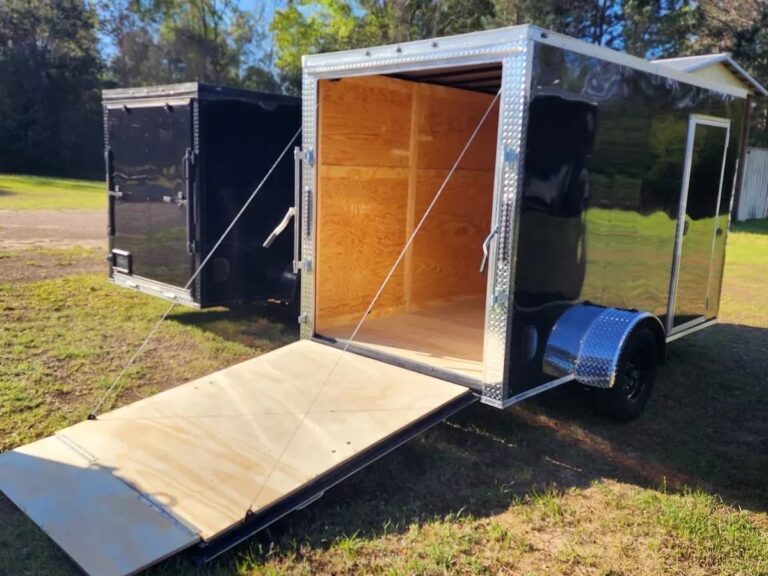
- Ramp door
- Side door
- Interior lighting
- V-nose
- D-rings
- E-track
- Shelving
- Roof vent
- Spare tire
- Interior wall lining
Actual dimensions and equipment vary by manufacturer, so buyers should always check the specific trailer’s specifications.
How Much Space Does a 5×8 Trailer Have?
A 5×8 provides approximately 40 square feet of floor area based on the nominal dimensions.
That doesn’t mean every inch is necessarily usable.
Interior space can be affected by:
- Wall thickness
- Wheel wells
- Door configuration
- Interior accessories
- Ramp design
- Floor construction
A 5×8 is therefore best suited to compact cargo rather than large machinery or oversized equipment.
Think in three dimensions
Before purchasing, measure:
Length × Width × Height
For example, if you’re transporting equipment that is 7 feet long, 4 feet wide, and 5 feet tall, you need to verify not only the floor dimensions but also the door opening and interior height.
What Can You Haul in a 5×8 Enclosed Trailer?
A 5×8 can be useful for a variety of relatively compact loads.
Potential applications include:
- Hand tools
- Contractor supplies
- Small landscaping equipment
- Lawn-care equipment
- Boxes
- Business inventory
- Motorcycle equipment
- Camping gear
- Sports equipment
- Event supplies
- Small recreational equipment
- Household goods
The exact cargo you can transport depends on the trailer’s actual dimensions and weight ratings.
Cargo weight still matters
A trailer can have enough physical space for an item but not enough payload capacity to carry it.
Always check the trailer’s:
- GVWR
- Empty weight
- Payload
- Axle rating
- Tire rating
- Brake configuration
5×8 Trailer Dimensions to Consider
When shopping for a 5×8, don’t stop at the advertised 5×8 dimensions.
There are several measurements you should verify.
|
Measurement |
Why It Matters |
|---|---|
|
Interior length |
Determines how much cargo fits front-to-back |
|
Interior width |
Determines side-to-side clearance |
|
Interior height |
Important for tall cargo |
|
Door width |
Determines what can physically enter |
|
Door height |
Important for tall equipment |
|
Floor height |
Affects loading |
|
Ramp length |
Affects loading angle |
|
Wheel-well placement |
Can reduce usable floor space |
This is especially important when transporting equipment with wheels, handles, attachments, or unusual shapes.
Understanding 5×8 Trailer Payload and GVWR
GVWR, or Gross Vehicle Weight Rating, is the maximum loaded weight for which the trailer is rated.
Payload is the amount of cargo the trailer can carry within its applicable ratings.
A simplified calculation is:
Payload ≈ GVWR − Empty Trailer Weight
For example, if a hypothetical 5×8 trailer has:
- GVWR: 3,500 lbs
- Empty weight: 1,500 lbs
The theoretical remaining capacity would be:
3,500 − 1,500 = 2,000 lbs
That is only an example.
The actual capacity of a particular 5×8 trailer must come from the manufacturer’s specifications.
Also remember that the lowest-rated component can affect the overall operating limitation.
Check:
- Axle rating
- Tire rating
- Coupler rating
- Frame specifications
- Brake configuration
Single Axle 5×8 Enclosed Trailers
Many compact enclosed cargo trailers use a single-axle configuration.
A single axle can be practical for a smaller trailer because it can help keep the overall trailer relatively compact and maneuverable.
Potential advantages include:
- Compact configuration
- Easier maneuverability
- Lower empty weight in some configurations
- Simpler maintenance
- Suitable for many lighter applications
However, don’t assume that every single-axle 5×8 trailer has the same payload.
Two trailers with the same nominal dimensions can have different:
- GVWRs
- Axle ratings
- Empty weights
- Tire ratings
- Braking systems
Always compare the actual specifications.
Important 5×8 Trailer Features
A compact trailer doesn’t mean you should ignore features.
The right features can make a significant difference in usability.
Ramp Door
A ramp door can make it easier to load:
- Motorcycles
- Carts
- Lawn equipment
- Wheeled tools
- Small machinery
If you’re frequently loading wheeled equipment, a ramp can be more convenient than lifting items over a conventional rear threshold.
Side Door
A side door provides an additional access point.
This can be useful when the trailer is being used for tools or business inventory.
Interior Lighting
Interior lights make it easier to find and organize cargo when loading or unloading after dark.
D-Rings
Tie-down points can help secure equipment during transportation.
E-Track
E-track can provide flexible cargo-securement and organization options when properly installed and rated.
V-Nose
A V-nose configuration changes the front profile and can provide additional design considerations for aerodynamics and storage.
5×8 Trailer Door Options
The rear door can have a major effect on how practical the trailer is.
Ramp Door
A ramp provides a gradual loading surface.
This can be especially useful for wheeled equipment.
Barn Doors
Barn-style doors can provide a large rear opening and convenient access for boxes, tools, and other cargo.
Side Door
A side door can make it easier to reach individual items without unloading the entire trailer.
When comparing trailers, consider how you actually plan to load and unload.
5×8 Enclosed Trailer for Contractors
A 5×8 can be useful for contractors who primarily need to transport tools and supplies rather than large machinery.
Potential cargo includes:
- Hand tools
- Power tools
- Cords
- Fasteners
- Small equipment
- Safety equipment
- Job-site supplies
The enclosed body also provides protection from weather and keeps tools out of direct view.
However, contractors carrying large equipment should compare the 5×8 against larger configurations.
A 6×12 Enclosed Cargo Trailer or larger configuration may provide more practical space depending on the application.
5×8 Enclosed Trailer for Landscaping
A 5×8 can be useful for smaller landscaping operations and lawn-care equipment.
Potential cargo includes:
- Trimmers
- Blowers
- Hand tools
- Small mowers where dimensions permit
- Landscaping supplies
- Fuel containers where properly stored and transported according to applicable requirements
Before purchasing, measure every piece of equipment that you plan to carry.
A 5×8 may work well for compact landscaping equipment but may be too small for larger commercial machinery.
For larger equipment, consider a larger enclosed trailer or an open configuration such as Utility Trailers, depending on the job.
5×8 Enclosed Trailer for Small Businesses
A 5×8 can also function as a compact mobile storage and transportation solution for a small business.
Potential uses include:
- Inventory
- Tools
- Promotional materials
- Event equipment
- Supplies
- Delivery items
- Mobile storage
The enclosed walls can also provide advertising space for a company’s:
- Logo
- Website
- Phone number
- Services
For a business that regularly carries larger inventory, however, the additional space of a 6×12 or larger trailer may be more practical.
5×8 Enclosed Trailer for Motorcycles and Recreation
A 5×8 can potentially work for certain recreational applications, including motorcycles, depending on the motorcycle’s dimensions, the trailer’s actual interior measurements, and the door configuration.
Before purchasing, measure:
- Motorcycle length
- Handlebar width
- Overall height
- Ground clearance
- Door opening
- Ramp width
You should also consider tie-down points and the trailer’s payload.
Don’t assume that a motorcycle will fit simply because the trailer is advertised as 5×8.
5×8 Enclosed Trailer vs. 5×10
The biggest difference is length.
A 5×10 provides approximately two additional feet of length compared with a 5×8.
|
Feature |
5×8 |
5×10 |
|---|---|---|
|
Approx. width |
5 ft |
5 ft |
|
Approx. length |
8 ft |
10 ft |
|
Floor space |
Smaller |
Larger |
|
Maneuverability |
Generally easier |
Still relatively compact |
|
Longer cargo |
More limited |
More flexibility |
|
Storage |
Less space |
More space |
|
Weight |
Often lower |
Can be higher |
|
Towing requirements |
Often lower |
Can be higher |
The 5×8 makes sense when compactness is important.
The 5×10 can make sense when you need additional length without moving to a significantly wider trailer.
For a broader comparison of trailer sizes, see Enclosed Cargo Trailer Sizes: How to Choose the Right Size.
5×8 Enclosed Trailer vs. Utility Trailer
An enclosed 5×8 and an open utility trailer can both transport equipment, but they serve different purposes.
|
Feature |
5×8 Enclosed Cargo |
Utility Trailer |
|---|---|---|
|
Roof |
Yes |
Usually no |
|
Weather protection |
High |
Limited |
|
Cargo visibility |
Low |
High |
|
Security |
Greater potential |
More exposed |
|
Side access |
Limited by walls |
Open |
|
Oversized cargo |
More restricted |
Often easier |
|
Protected storage |
Yes |
No |
|
Interior organization |
Excellent |
Limited |
Choose the enclosed trailer when protecting and securing cargo is important.
Choose an open trailer when fast loading, easy side access, or oversized cargo is more important.
You can explore Utility Trailers if an open configuration better matches your application.
What Tow Vehicle Do You Need?
A 5×8 is relatively compact, but you still need to match it with an appropriately rated tow vehicle.
Before buying, check:
- Vehicle tow rating
- Vehicle payload
- Hitch rating
- Tongue-weight limit
- Trailer GVWR
- Trailer empty weight
- Expected cargo weight
Don’t judge towing requirements based solely on trailer dimensions.
Two 5×8 trailers can have very different weights and ratings.
New vs. Used 5×8 Enclosed Trailer
A new trailer gives you the opportunity to choose your preferred configuration and specifications.
A used trailer can provide another purchasing option, but condition becomes particularly important.
When inspecting a used 5×8, check:
Exterior
- Roof
- Walls
- Doors
- Seals
- Frame
Running gear
- Tires
- Wheels
- Axle
- Suspension
- Bearings
Electrical
- Brake lights
- Turn signals
- Running lights
- Wiring
- Connector
Interior
- Floor
- Walls
- Roof
- Water damage
- Odors
- Previous modifications
Don’t overlook the floor.
Water intrusion can cause deterioration that isn’t immediately obvious from outside the trailer.
5×8 Enclosed Trailer Maintenance
Regular maintenance helps keep a compact trailer ready for work.
Inspect the:
Tires
Check pressure, tread, sidewalls, cracks, and uneven wear.
Wheels
Check for damage and properly maintained lug nuts.
Bearings
Follow the manufacturer’s recommended inspection and service intervals.
Brakes
Where equipped, inspect and maintain the braking system according to manufacturer instructions.
Coupler
Check the coupler and locking mechanism before towing.
Lights
Test:
- Brake lights
- Turn signals
- Running lights
Roof and seals
Look for water intrusion and damaged seals.
Floor
Inspect for:
- Soft spots
- Rot
- Cracks
- Water damage
Doors
Check hinges, latches, alignment, and seals.
How to Decide if a 5×8 Is Right for You
A 5×8 enclosed cargo trailer may be appropriate if:
- Your cargo is relatively compact
- You prioritize maneuverability
- You have limited storage space
- Your tow vehicle has limited capacity
- You don’t need a large interior workspace
- You primarily transport tools and smaller equipment
You may want to consider a larger trailer if:
- Your equipment is growing
- You regularly transport multiple pieces of equipment
- You need additional interior workspace
- You frequently run out of room
- You need more cargo weight capacity
If you’re unsure, measure your largest expected cargo and compare those measurements with the actual trailer specifications.
5×8 Enclosed Cargo Trailer Buying Checklist
|
Category |
What to Check |
|---|---|
|
Interior length |
Is 8 ft enough for your cargo? |
|
Interior width |
Is there enough side clearance? |
|
Interior height |
Will tall equipment fit? |
|
Door opening |
Can your cargo enter? |
|
GVWR |
What is the maximum rated loaded weight? |
|
Payload |
How much cargo can it carry? |
|
Axle |
What is the axle rating? |
|
Tires |
Are they properly rated? |
|
Brakes |
Are brakes included or required for your application? |
|
Ramp |
Do you need one? |
|
Side door |
Would additional access help? |
|
Tie-downs |
Are securement points available? |
|
Tow vehicle |
Can your vehicle handle the loaded trailer? |
|
Storage |
Do you have enough room to park it? |
Frequently Asked Questions
Is a 5×8 enclosed trailer big enough?
A 5×8 can be sufficient for compact tools, supplies, small equipment, recreational gear, and other relatively small cargo. Whether it’s big enough depends on your cargo’s actual dimensions and weight.
How much can a 5×8 enclosed trailer carry?
There is no single payload number for every 5×8 trailer. Payload depends on the specific trailer’s GVWR, empty weight, axle rating, tires, and other components.
Can a 5×8 enclosed trailer carry a motorcycle?
Some motorcycles can fit in a 5×8, but you should measure the motorcycle and compare its dimensions with the trailer’s actual interior and door opening.
Is a 5×8 good for landscaping?
It can be useful for compact landscaping and lawn-care equipment. Larger commercial equipment may require a larger trailer.
Is a 5×8 better than a 5×10?
Neither is universally better. A 5×8 is more compact, while a 5×10 provides additional length. The right choice depends on your cargo and towing requirements.
Can an SUV tow a 5×8 enclosed trailer?
Some SUVs can tow certain 5×8 trailers, but towing capability varies significantly between vehicles. Check your vehicle’s actual tow rating, payload, hitch rating, and the loaded trailer weight.
Should I buy a 5×8 or a larger trailer?
Choose the 5×8 if it comfortably accommodates your current cargo and expected needs. If you regularly need more room, buying a larger trailer may be more practical than repeatedly working with limited space.
Final Thoughts
A 5×8 enclosed cargo trailer can be an excellent compact solution for buyers who need protected cargo space without moving to a larger trailer.
Its relatively small footprint can make it easier to maneuver, tow, park, and store while still providing an enclosed area for tools, supplies, equipment, inventory, and recreational cargo.
Before purchasing, focus on the things that actually determine whether the trailer will work for you:
- Cargo dimensions
- Cargo weight
- Interior height
- Door opening
- GVWR
- Payload
- Axle rating
- Tire rating
- Brakes
- Tow vehicle
- Storage space
Don’t choose a trailer simply because your cargo technically fits. Leave enough practical room for loading, unloading, tie-downs, and the way you actually use the trailer.
For a broader understanding of available sizes, read Enclosed Cargo Trailer Sizes: How to Choose the Right Size.
For the complete purchasing process, visit Enclosed Cargo Trailer Buying Guide: How to Choose the Right Trailer for Secure Transport.
And for a general introduction to the category, see What Is an Enclosed Cargo Trailer? Complete Guide for Buyers.
When you’re ready to compare actual products, browse Enclosed Cargo Trailers.
If your cargo is better suited to an open deck, explore Utility Trailers. For wide or heavy equipment, Deck-Over Trailers may be a better configuration. For loose materials that need to be unloaded hydraulically, Dump Trailers is the appropriate specialized category. And for transporting horses or livestock, explore Horse Trailers & Stock Trailers.
The best 5×8 enclosed trailer is not simply the one that fits your cargo—it is the one that provides the right combination of space, payload, features, towing compatibility, and practical usability for the work you actually need to do.
For safe towing and loading practices, visit the NHTSA trailer safety guidelines.
