

Table of Contents
ToggleWhat Is an Enclosed Cargo Trailer? Complete Guide for Buyers
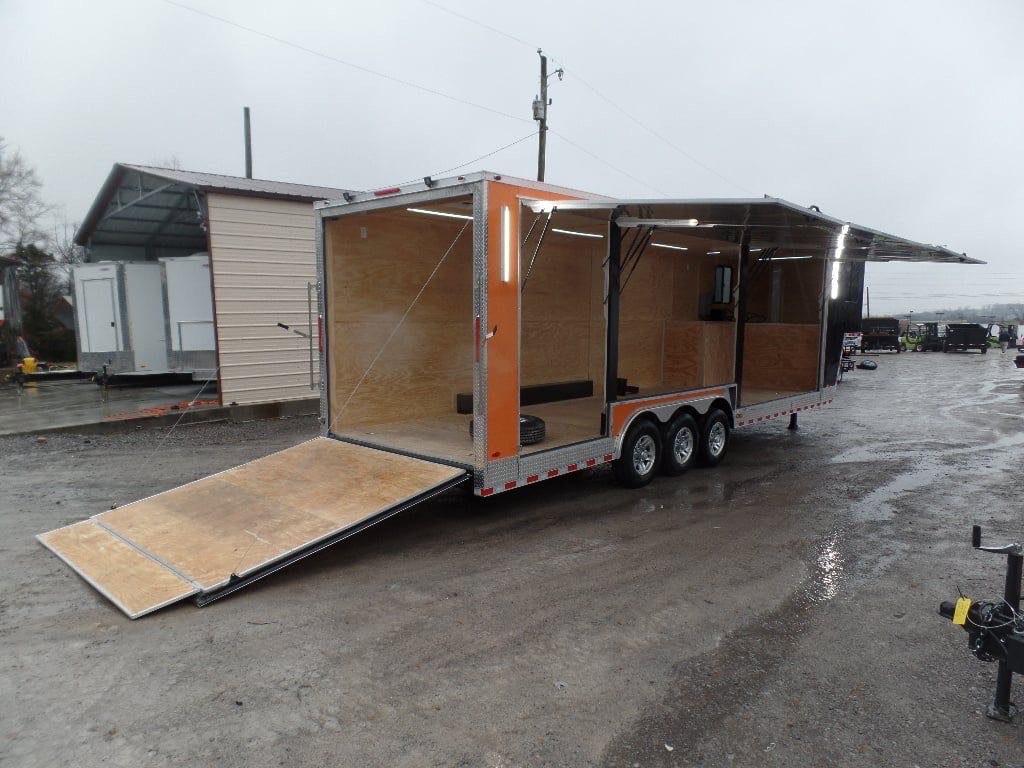
An enclosed cargo trailer is a trailer with a roof, walls, and enclosed cargo area designed to transport and protect tools, equipment, merchandise, materials, motorcycles, household items, and other goods.
Unlike an open trailer, an enclosed cargo trailer surrounds the cargo with a protected interior space. This helps shield the load from rain, snow, sunlight, dust, road spray, and other outside conditions.
Enclosed cargo trailers are commonly used by contractors, landscapers, tradespeople, delivery businesses, movers, recreational users, and small businesses.
For a complete purchasing strategy, start with the Enclosed Cargo Trailer Buying Guide: How to Choose the Right Trailer for Secure Transport.
This guide focuses specifically on what an enclosed cargo trailer is, how it works, what you can haul, the different configurations available, and what to consider before buying.
What Is an Enclosed Cargo Trailer?
An enclosed cargo trailer is a towable trailer that provides a protected interior cargo area.
A typical enclosed trailer consists of:
- A frame
- Axles
- Suspension
- Wheels and tires
- Coupler
- Floor
- Side walls
- Roof
- Rear door
- Electrical system
- Exterior lighting
Depending on the model, it may also include:
- Ramp doors
- Side doors
- Interior lighting
- V-nose construction
- E-track
- D-rings
- Shelving
- Cabinets
- Roof vents
- Windows
- Spare tire
- Interior wall lining
The exact configuration depends on the trailer’s size, weight rating, construction, and intended application.
If you’re ready to compare available models, browse Enclosed Cargo Trailers.
How Does an Enclosed Cargo Trailer Work?
An enclosed cargo trailer connects to a tow vehicle through a coupler and hitch system.
The tow vehicle pulls the trailer while the trailer’s axles, suspension, tires, and frame support the trailer and its cargo.
The enclosed body creates a protected cargo compartment.
Major Components
Component | Primary Function |
|---|---|
Frame | Supports the overall trailer structure |
Axles | Support the trailer and wheels |
Suspension | Helps absorb road impacts |
Tires | Support the trailer and provide road contact |
Coupler | Connects the trailer to the tow vehicle |
Brakes | Help slow the trailer where equipped |
Floor | Supports cargo |
Walls | Protect cargo from the sides |
Roof | Provides overhead protection |
Rear door | Provides access to the cargo area |
Lights | Provide visibility and signaling |
Because every component contributes to how the trailer operates, buyers should evaluate the complete trailer rather than choosing based only on its exterior size.
What Can You Haul in an Enclosed Cargo Trailer?
One of the biggest advantages of an enclosed cargo trailer is versatility.
Depending on its size, interior configuration, payload capacity, and door arrangement, an enclosed trailer can transport:
- Construction tools
- Landscaping equipment
- Lawn-care equipment
- Motorcycles
- Furniture
- Appliances
- Boxes
- Business inventory
- Event equipment
- Sports equipment
- Camping equipment
- Building supplies
- Small machinery
- Trade-show equipment
However, fitting cargo inside the trailer is only one part of choosing the right trailer.
You also need to consider cargo weight.
A trailer must be operated within its applicable GVWR, axle, tire, and other component ratings.
A trailer may have enough interior space for a particular piece of equipment but still not have enough payload capacity for that equipment.
Benefits of an Enclosed Cargo Trailer
1. Protection From Weather
The enclosed structure helps protect cargo from:
- Rain
- Snow
- Sun
- Wind
- Dust
- Road spray
This can be particularly valuable when transporting tools, electronics, merchandise, building materials, or other items that should remain protected.
2. Additional Cargo Security
The enclosed body keeps the contents out of direct view.
With appropriate locks and security hardware, it can provide an additional layer of protection compared with an open trailer.
3. Mobile Storage
An enclosed trailer can also function as a mobile storage area.
For contractors and service businesses, tools and equipment can remain organized inside the trailer instead of being loaded and unloaded after every job.
4. Business Branding
The exterior walls provide substantial space for:
- Company logos
- Phone numbers
- Websites
- Services
- Business names
For many businesses, an enclosed trailer can therefore serve both a transportation and marketing purpose.
5. Better Organization
Interior accessories can turn an empty cargo trailer into a more organized mobile workspace.
Common additions include:
- Shelving
- Cabinets
- E-track
- D-rings
- Tool storage
- Workbenches
Enclosed Cargo Trailer vs. Utility Trailer
One of the most common comparisons buyers make is between an enclosed cargo trailer and a utility trailer.
An enclosed trailer provides a protected interior, while a utility trailer provides an open deck.
For buyers considering an open alternative, Utility Trailers is the relevant product category to explore.
Feature | Enclosed Cargo Trailer | Utility Trailer |
|---|---|---|
Roof | Yes | Usually no |
Side walls | Yes | Usually open |
Weather protection | High | Limited |
Cargo visibility | Low | High |
Security | Greater potential | More exposed |
Interior storage | Yes | No enclosed storage |
Oversized cargo | More limited | Often easier |
Branding space | Excellent | More limited |
Typical use | Protected cargo and equipment | Open loads and equipment |
Neither trailer type is automatically right for every application.
Choose based on what you need to transport and how you need to load it.
Enclosed Cargo Trailer vs. Other Trailer Types
An enclosed cargo trailer isn’t designed for every type of hauling job.
Different trailer categories serve different purposes.
Enclosed Cargo vs. Dump Trailers
A dump trailer is designed primarily for hauling and unloading loose materials by raising the bed.
An enclosed cargo trailer is designed around protected interior cargo space.
If your primary need is hauling and dumping materials such as dirt, gravel, mulch, or debris, Dump Trailers may be more appropriate.
Enclosed Cargo vs. Deck-Over Trailers
A deck-over trailer provides a wide, open deck positioned over the wheels.
This makes it useful for certain equipment, machinery, and wide loads.
An enclosed trailer instead prioritizes protected interior cargo space.
For equipment that requires a wide open deck, see Deck-Over Trailers.
Enclosed Cargo vs. Horse & Stock Trailers
Horse and stock trailers are specifically designed around transporting animals.
They can include features such as:
- Animal compartments
- Ventilation
- Dividers
- Specialized doors
- Livestock access
A standard enclosed cargo trailer is not a substitute for a purpose-built animal trailer.
If your intended cargo is horses or livestock, explore Horse Trailers & Stock Trailers instead.
Enclosed Cargo vs. Lowdeck Trailers
Lowdeck trailers are designed with a lower deck configuration that can provide different loading and equipment-hauling advantages.
For buyers comparing alternative trailer designs, Lowdeck Trailers provides another category to consider.
Common Enclosed Cargo Trailer Sizes
Enclosed cargo trailers come in a wide range of dimensions.
Common widths include:
- 5 feet
- 6 feet
- 7 feet
- 8.5 feet
Common lengths include:
- 8 feet
- 10 feet
- 12 feet
- 14 feet
- 16 feet
- 20 feet
- Longer configurations
Some common size examples include:
Size | Potential Application |
|---|---|
5×8 | Compact cargo, tools and small equipment |
5×10 | Additional floor space for equipment and supplies |
6×12 | General equipment and business use |
7×14 | Larger equipment and commercial applications |
7×16 | Larger cargo, equipment and mobile workspace |
8.5×16+ | Larger commercial and specialized applications |
These are general examples.
Actual usable space depends on:
- Interior dimensions
- Wall construction
- Interior height
- Door opening
- Wheel-well configuration
- Ramp design
- Interior accessories
A trailer’s advertised dimensions should therefore be compared with its actual usable interior space.
Single Axle vs. Tandem Axle Enclosed Trailers
Axle configuration is another major consideration.
Single-Axle Enclosed Trailers
A single-axle trailer uses one axle to support the trailer.
These trailers are commonly associated with smaller configurations and lighter applications.
Potential advantages include:
- Simpler configuration
- Lower trailer weight
- Easier maneuverability
- Suitability for lighter cargo
Tandem-Axle Enclosed Trailers
Tandem-axle trailers use two axles.
They are commonly used on larger enclosed trailers designed for heavier cargo.
Potential advantages can include:
- Greater load-support capability depending on ratings
- Additional support for larger trailer bodies
- Suitability for heavier applications
The important point is that axle count alone doesn’t determine the trailer’s capacity.
Always check the manufacturer’s actual GVWR, axle ratings, tires, brakes, and payload specifications.
Important Enclosed Cargo Trailer Features
When shopping for an enclosed cargo trailer, don’t focus only on length and width.
The configuration can make a major difference in how useful the trailer is.
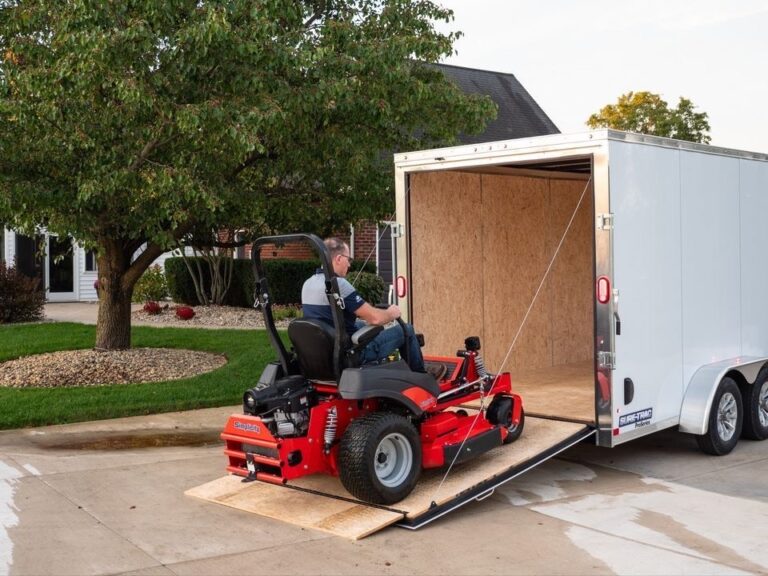
Ramp Door
A ramp door can make loading wheeled equipment much easier.
This can be useful for:
- Motorcycles
- Lawn equipment
- Small machinery
- Carts
- Equipment
Side Door
A side access door lets you enter the cargo area without opening the rear door.
This can be especially convenient for contractors who frequently access tools.
V-Nose
A V-nose front changes the shape of the trailer’s front section and can provide additional design and storage considerations.
Interior Height
Interior height is critical when transporting tall equipment.
Don’t choose a trailer based only on floor dimensions.
Consider:
Length + width + height.
Tie-Down Points
D-rings and E-track systems can make cargo securement and organization easier.
Interior Lighting
Interior lights are useful for loading and unloading in low-light conditions.
Ventilation
Roof or side vents can provide airflow for applications where ventilation is important.
Understanding GVWR and Payload
GVWR means Gross Vehicle Weight Rating.
It represents the maximum loaded weight for which the trailer is rated.
Payload refers to the cargo weight the trailer can carry within its applicable ratings.
A simplified calculation is:
Payload ≈ GVWR − Empty Trailer Weight
For example:
- GVWR: 7,000 lbs
- Empty trailer weight: 2,500 lbs
Approximate remaining capacity:
7,000 − 2,500 = 4,500 lbs
This is only an example.
Always use the actual manufacturer’s specifications and certification information for the trailer you’re purchasing.
Also consider:
- Axle ratings
- Tire ratings
- Coupler rating
- Hitch rating
- Tow vehicle capacity
What Vehicle Can Tow an Enclosed Cargo Trailer?
The fact that a trailer can connect to a vehicle does not automatically mean the vehicle can safely tow it at its maximum rating.
Before buying, compare:
- Trailer GVWR
- Empty trailer weight
- Expected cargo weight
- Tow vehicle rating
- Hitch rating
- Tongue-weight capacity
- Vehicle payload capacity
You should evaluate the entire towing combination, not just the trailer.
Enclosed Cargo Trailers for Different Applications
Contractors
Contractors can use enclosed trailers for:
- Power tools
- Hand tools
- Generators
- Compressors
- Building supplies
- Job-site equipment
Interior organization can be especially valuable for contractors who move between multiple jobs.
Landscapers
Landscapers may use enclosed trailers for:
- Trimmers
- Blowers
- Hand tools
- Supplies
- Small equipment
Larger equipment may require a different trailer configuration depending on its size and weight.
Movers
Enclosed trailers can transport:
- Furniture
- Boxes
- Appliances
- Household items
Interior dimensions and payload are particularly important for moving applications.
Small Businesses
An enclosed trailer can be used for:
- Inventory
- Mobile storage
- Equipment
- Deliveries
- Events
- Trade shows
This can make the trailer a useful extension of a small business.
Recreational Users
Enclosed trailers can also transport:
- Motorcycles
- ATVs where dimensions permit
- Sports equipment
- Camping gear
- Recreational equipment
Always verify that the trailer’s interior dimensions and payload are appropriate for the specific equipment.
Enclosed Cargo Trailer Construction
The materials used in an enclosed trailer affect weight, durability, maintenance, and cost.
Common construction materials include:
Steel
Steel is widely used for trailer frames and structural components.
Potential advantages include:
- Strength
- Structural durability
- Wide availability
Aluminum
Aluminum can be used in various trailer components and may help reduce weight depending on the overall construction.
Potential benefits can include:
- Lower weight
- Corrosion resistance
- Different maintenance characteristics
However, the quality of the complete trailer matters more than choosing a material based on one characteristic.
When comparing trailers, consider the:
- Frame
- Walls
- Floor
- Roof
- Fasteners
- Doors
- Axles
- Overall construction
New vs. Used Enclosed Cargo Trailers
Both new and used enclosed cargo trailers can meet different buyer requirements.
When inspecting a used trailer, pay close attention to:
- Frame
- Floor
- Roof
- Walls
- Tires
- Axles
- Suspension
- Brakes
- Wiring
- Doors
- Hinges
- Ramp
- Coupler
- Water intrusion
- Previous repairs
Don’t judge a used enclosed trailer solely by its exterior appearance.
A trailer can look good from the outside while having problems with its floor, roof, wiring, bearings, or structural components.
How Much Does an Enclosed Cargo Trailer Cost?
The price of an enclosed cargo trailer depends on its configuration.
Major factors include:
- Length
- Width
- Height
- GVWR
- Axle configuration
- Brakes
- Door configuration
- Ramp
- Construction
- Interior finish
- Electrical equipment
- Storage options
- Accessories
- Condition
A compact enclosed trailer and a large commercial enclosed trailer can have dramatically different specifications and prices.
Therefore, don’t compare price alone.
Compare the specifications and intended use alongside the price.
Enclosed Cargo Trailer Maintenance
Regular maintenance helps keep an enclosed cargo trailer ready for work.
Tires
Check:
- Tire pressure
- Tread
- Sidewalls
- Cracks
- Uneven wear
Brakes
Inspect and service the braking system according to the manufacturer’s recommendations.
Bearings
Service wheel bearings according to the manufacturer’s recommended schedule.
Roof and Seals
Inspect for:
- Water intrusion
- Damaged seals
- Cracks
- Loose components
Doors
Check:
- Hinges
- Latches
- Seals
- Alignment
Floor
Look for:
- Soft spots
- Water damage
- Cracks
- Loose sections
Electrical System
Check:
- Brake lights
- Turn signals
- Running lights
- Interior lights
- Wiring
- Connectors
Regular inspections can help identify problems before they become more expensive repairs.
How to Choose the Right Enclosed Cargo Trailer
Before buying, start with your actual use.
Step 1: Identify Your Cargo
Determine exactly what you intend to transport.
Step 2: Measure Your Cargo
Measure:
- Length
- Width
- Height
Don’t forget to account for doors and loading clearance.
Step 3: Determine Cargo Weight
Knowing the weight of your equipment or goods is essential.
Step 4: Determine Required Payload
Make sure the trailer can carry the cargo within its applicable ratings.
Step 5: Choose the Appropriate Size
Avoid buying a trailer that’s unnecessarily small.
But don’t automatically buy the largest trailer available either.
A larger trailer can add weight, affect towing requirements, and cost more.
Step 6: Choose the Door Configuration
Consider whether you need:
- Ramp door
- Barn doors
- Side door
- Multiple access points
Step 7: Check Your Tow Vehicle
Verify the vehicle’s towing and payload capabilities.
Step 8: Consider Your Future Needs
If you expect your business or equipment collection to grow, consider whether the trailer will still meet your requirements later.
Enclosed Cargo Trailer Buying Checklist
Category | What to Check |
|---|---|
Size | Length, width and interior height |
GVWR | Maximum rated loaded weight |
Payload | Available cargo capacity |
Axles | Single or tandem |
Brakes | Type and configuration |
Tires | Size, condition and load rating |
Doors | Ramp, rear and side access |
Floor | Material and construction |
Roof | Construction and weather protection |
Tie-downs | D-rings, E-track and other systems |
Lighting | Exterior and interior |
Security | Locks and door hardware |
Towing | Vehicle and hitch compatibility |
Maintenance | Tires, brakes, bearings and seals |
Frequently Asked Questions
What is an enclosed cargo trailer used for?
An enclosed cargo trailer is used to transport and protect tools, equipment, merchandise, motorcycles, household goods, business inventory, and many other types of cargo.
Is an enclosed cargo trailer better than a utility trailer?
They serve different purposes. An enclosed trailer provides greater protection and security, while a utility trailer provides an open loading area and can be better suited to certain oversized or easily accessible loads.
What is a good enclosed trailer size?
The appropriate size depends on your cargo. Smaller trailers such as 5×8 can work for compact loads, while 6×12, 7×14, 7×16, and larger configurations provide more space for equipment and commercial applications.
Can an enclosed cargo trailer be used for business?
Yes. Contractors, landscapers, tradespeople, delivery businesses, and other companies can use enclosed trailers for transporting equipment, supplies, tools, and inventory.
Do enclosed cargo trailers have brakes?
Many enclosed trailers, especially larger and heavier configurations, can be equipped with brakes. The appropriate setup depends on the trailer configuration and applicable requirements.
Can an enclosed cargo trailer be used as storage?
Yes. Many owners use enclosed trailers for mobile or temporary storage, provided the trailer is properly configured and maintained.
Is an enclosed cargo trailer suitable for horses or livestock?
A standard enclosed cargo trailer is designed for general cargo rather than animal transportation. Buyers transporting horses or livestock should look at purpose-built Horse Trailers & Stock Trailers designed for those applications.
How do I choose an enclosed cargo trailer?
Start with the cargo you need to transport. Determine the required dimensions, weight, payload, GVWR, axle configuration, door configuration, and tow-vehicle requirements before selecting a trailer.
Final Thoughts
An enclosed cargo trailer provides a combination of transportation, protection, security, and storage that makes it useful for a wide range of personal and commercial applications.
The right trailer isn’t necessarily the biggest or most expensive model. It is the one whose dimensions, payload, GVWR, axle configuration, doors, construction, and towing requirements match the job you actually need to perform.
Before purchasing, consider:
- What you’re hauling
- Cargo dimensions
- Cargo weight
- Trailer dimensions
- GVWR
- Payload
- Axle configuration
- Brakes
- Ramp and door configuration
- Interior height
- Tie-down options
- Tow vehicle compatibility
For the complete purchasing process, visit Enclosed Cargo Trailer Buying Guide: How to Choose the Right Trailer for Secure Transport.
When you’re ready to compare available models, browse Enclosed Cargo Trailers.
If you’re deciding between an enclosed and open configuration, compare Utility Trailers as well. For wide or heavy equipment requiring an open deck, explore Deck-Over Trailers. If your intended use involves transporting horses or livestock, Horse Trailers & Stock Trailers is the more appropriate category to explore.
For material-hauling applications where dumping is the primary purpose, Dump Trailers provides another specialized option.
With the right configuration, an enclosed cargo trailer can provide a dependable way to transport tools, equipment, merchandise, supplies, and other valuable cargo while keeping the load protected throughout the trip.
For other hauling requirements, explore our Utility Trailers, Deck-Over Trailers, Lowdeck Trailers, Enclosed Cargo Trailers, Horse Trailers & Stock Trailers, and Accessories.
For safe towing and loading practices, visit the NHTSA trailer safety guidelines.
