
Table of Contents
ToggleGooseneck vs. Bumper-Pull Horse Trailers: Which Is Right for You?
Choosing between a gooseneck and a bumper-pull horse trailer is an important decision for horse owners, equestrian businesses, trainers, and riders who regularly transport horses.
Both configurations can provide safe and practical transportation when properly selected, maintained, loaded, and towed. However, they differ in hitch design, vehicle requirements, available configurations, and the demands they place on the towing setup.
A bumper-pull horse trailer connects to a receiver hitch at the rear of a suitable tow vehicle. A gooseneck horse trailer connects to a specialized hitch generally installed in the bed of a compatible pickup truck.
The right option depends on the trailer you need, how many horses you transport, your tow vehicle’s capabilities, and your budget.
If you’re beginning your search, start with our Horse and Stock Trailer Buying Guide: How to Choose the Right Trailer for Safe Livestock Transport. This pillar guide covers the main considerations when choosing a suitable trailer.
In this guide, we’ll compare gooseneck and bumper-pull horse trailers so you can make a more informed purchasing decision.
1. Gooseneck vs. Bumper-Pull Horse Trailers at a Glance
Here’s a quick comparison of the two configurations.
Feature | Bumper-Pull Horse Trailer | Gooseneck Horse Trailer |
|---|---|---|
Hitch location | Receiver hitch at the rear of the tow vehicle | Specialized hitch in the bed of a compatible pickup |
Tow vehicle | Must have suitable towing and hitch capacity | Generally requires a compatible pickup truck |
Available sizes | Vary by manufacturer | Vary by manufacturer |
Horse capacity | Depends on the specific model | Depends on the specific model |
Towing characteristics | Depend on loading, design, and vehicle compatibility | Depend on loading, design, and vehicle compatibility |
Pickup bed availability | Remains available | Hitch occupies part of the pickup bed |
Initial cost | May be lower for comparable smaller configurations | May be higher, depending on configuration |
Hitch installation | Requires a suitable receiver hitch | Requires a compatible gooseneck hitch |
Best for | Owners whose needs suit a receiver-hitch configuration | Owners whose needs suit a pickup-bed hitch configuration |
Neither option is automatically better for every buyer.
The correct choice depends on the complete towing setup and the specific horse trailer you’re considering.
2. What Is a Bumper-Pull Horse Trailer?
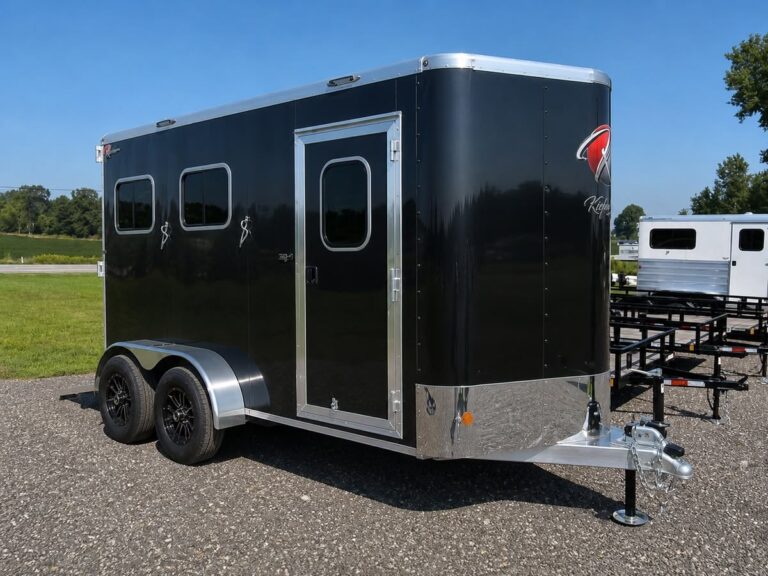
A bumper-pull horse trailer connects to a compatible receiver hitch installed at the rear of the tow vehicle.
Despite the common name, the trailer should connect to a properly rated hitch system rather than being attached directly to a vehicle’s bumper unless the vehicle manufacturer explicitly permits that arrangement.
Bumper-pull trailers are available in different sizes and configurations, including models designed for two horses and other applications.
Advantages of Bumper-Pull Horse Trailers
Lower initial cost: Some bumper-pull configurations cost less than comparable larger gooseneck models.
No gooseneck hitch in the pickup bed: This can be useful if you regularly use your pickup for other purposes.
Compatibility with suitable tow vehicles: A properly rated SUV, truck, or other approved tow vehicle may be able to tow a bumper-pull trailer.
Practical for smaller transportation needs: Some horse owners don’t need the size or capacity of a larger gooseneck trailer.
Potential Disadvantages
Bumper-pull trailers still require careful attention to weight distribution, hitch ratings, and towing compatibility.
Depending on the trailer and vehicle, they may also be more susceptible to sway if incorrectly loaded or improperly matched to the tow vehicle.
Proper loading, suitable equipment, and safe driving practices are essential regardless of hitch type.
For buyers who normally transport one or two horses, our Two-Horse vs. Three-Horse Trailers: Which Is Right for You? guide can help you assess the capacity you actually need before choosing a hitch configuration.
3. What Is a Gooseneck Horse Trailer?
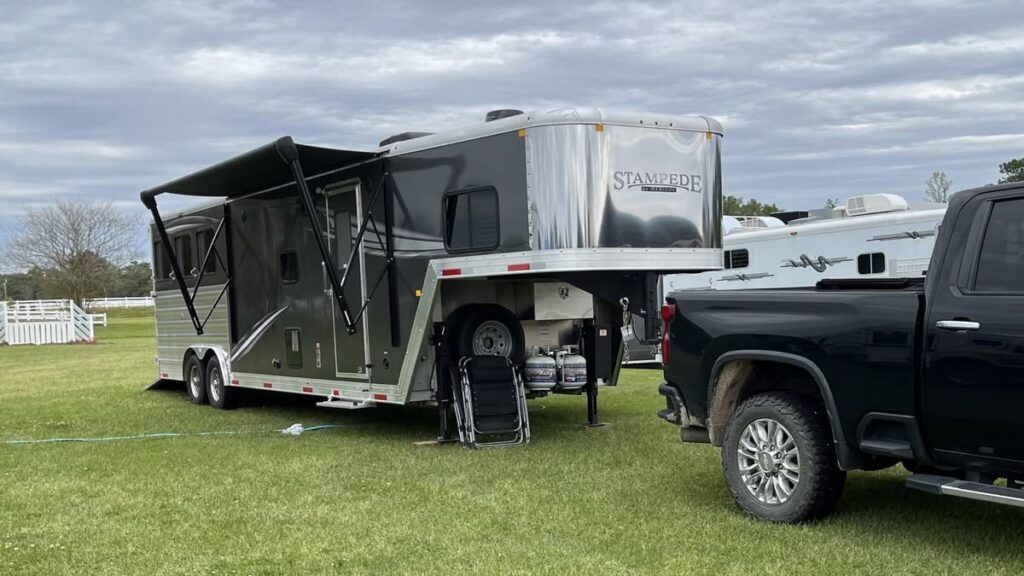
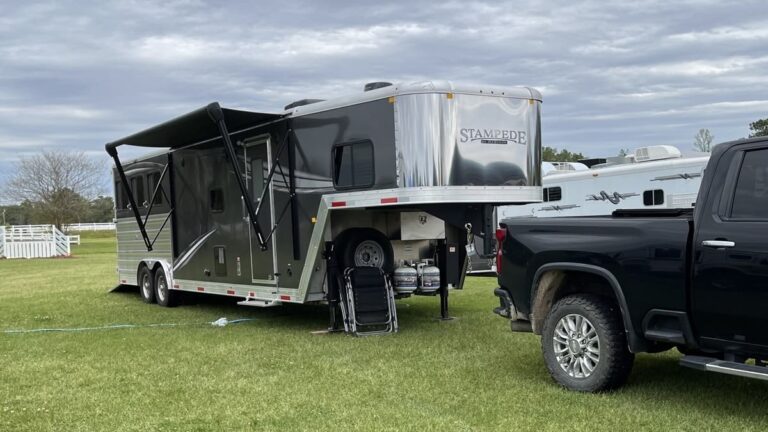
A gooseneck horse trailer connects to a specialized hitch generally installed in the bed of a compatible pickup truck.
The trailer’s forward structure extends over the rear portion of the pickup, allowing the hitch connection to sit above or near the truck’s rear axle.
Gooseneck horse trailers are commonly available in larger configurations, including models designed to transport several horses.
Some models also include additional storage or living quarters.
Advantages of Gooseneck Horse Trailers
Availability of larger configurations: Gooseneck designs are commonly used for many larger horse trailers.
Different weight-distribution characteristics: The hitch position can influence how the trailer’s load is distributed across the towing vehicle.
Potential suitability for frequent commercial use: Some larger models may suit trainers and equestrian businesses that transport multiple horses.
Dedicated hitch arrangement: A properly installed hitch provides a connection point designed for the trailer.
Potential Disadvantages
- Requires a compatible pickup truck.
- Requires a properly installed and rated gooseneck hitch.
- Uses part of the pickup bed.
- May involve higher purchase and installation costs.
- Larger models may require greater towing and payload capacity.
A gooseneck hitch does not automatically make an overloaded or poorly balanced trailer safe. The entire towing combination must remain within its rated limits.
When comparing available options, browse our Horse & Stock Trailers product category to explore the relevant trailer options offered by Universal Trailers Line.
4. Key Differences Between Gooseneck and Bumper-Pull Trailers
The biggest differences involve the hitch arrangement, tow vehicle requirements, available configurations, and practical ownership considerations.
Hitch Location
A bumper-pull trailer connects to a receiver hitch at the rear of the tow vehicle.
A gooseneck trailer connects to a specialized hitch in the bed of a compatible pickup.
This difference affects which vehicles can tow each trailer and how the hitch installation is handled.
Vehicle Compatibility
A bumper-pull trailer may be compatible with several types of tow vehicles, provided the vehicle and hitch are rated for the loaded trailer.
A gooseneck trailer generally requires a suitable pickup truck with a compatible hitch installation.
Trailer Size
Both hitch types are available in different sizes, but gooseneck designs are commonly used for larger horse trailers.
Do not choose based on hitch type alone. Compare the actual dimensions, empty weight, GVWR, payload capacity, and manufacturer’s towing recommendations.
Everyday Convenience
A bumper-pull configuration may be more convenient if you don’t want a hitch occupying space in your pickup bed.
A gooseneck configuration may be more practical if you already own a compatible pickup and regularly transport a larger trailer.
5. Towing Stability and Handling
Towing behavior depends on more than whether a trailer uses a bumper-pull or gooseneck hitch.
Important factors include:
- Tow vehicle suitability.
- Trailer weight.
- Weight distribution.
- Tongue or pin weight.
- Trailer length.
- Tire condition and pressure.
- Hitch installation.
- Braking system.
- Driving speed.
- Road and weather conditions.
Bumper-Pull Handling
Bumper-pull trailers can tow safely when the vehicle, hitch, and trailer are appropriately matched.
However, improper loading or insufficient tongue weight can contribute to sway and unstable handling.
Gooseneck Handling
A gooseneck hitch connects farther forward on the pickup than a conventional receiver hitch.
This can provide different handling characteristics and may be beneficial for certain larger trailer configurations.
However, correct weight distribution and compliance with the truck’s payload and hitch ratings remain essential.
Neither hitch type eliminates the need for proper loading, suitable equipment, and safe driving.
If you’re unsure about the towing requirements, consult the vehicle and trailer manufacturers or a qualified towing professional.
6. Towing Vehicle Requirements
Your tow vehicle is one of the most important factors in deciding between the two trailer types.
Before purchasing, check the manufacturer’s specifications for your vehicle.
Bumper-Pull Requirements
Confirm that the vehicle has:
- An appropriate receiver hitch.
- Sufficient maximum trailer weight capacity.
- Adequate payload capacity.
- A suitable braking and electrical connection.
- Sufficient capacity for the loaded trailer’s tongue weight.
Gooseneck Requirements
Confirm that the pickup has:
- Sufficient towing capacity.
- Adequate payload capacity.
- A compatible gooseneck hitch.
- Sufficient hitch and pin-weight capacity.
- Appropriate tires and suspension.
- The required trailer-brake and electrical connections.
Why Payload Capacity Matters
A vehicle’s towing capacity does not tell you everything about how much weight it can safely carry.
The weight placed on the hitch also affects the vehicle’s available payload.
Passengers, cargo, accessories, and hitch equipment must be considered alongside the trailer’s loaded weight.
Check all applicable manufacturer ratings before purchasing.
7. Horse Capacity and Trailer Size
Both gooseneck and bumper-pull horse trailers come in different configurations.
The right size depends on the number and size of the horses, interior dimensions, and the weight ratings of the trailer.
Comparing Typical Applications
Application | Potentially Suitable Configuration | Important Considerations |
|---|---|---|
Transporting one or two horses | Suitable bumper-pull or gooseneck model | Interior dimensions and vehicle ratings |
Transporting several horses | A model specifically designed for the required capacity | Stall dimensions, payload, and towing requirements |
Frequent equestrian travel | Either configuration, depending on requirements | Reliability, loading access, and maintenance |
Larger equestrian operation | A suitable larger model, often available in gooseneck designs | Truck capability, storage, and operating costs |
These are general examples, not fixed rules.
A smaller gooseneck trailer may suit some buyers, while a properly rated bumper-pull trailer may meet other buyers’ needs.
Don’t Forget Interior Dimensions
Check:
- Interior height.
- Stall width and length.
- Door opening dimensions.
- Ramp dimensions, if fitted.
- Ventilation.
- Overall trailer length and width.
For a closer look at the measurements that matter, read our Horse Trailer Sizes Explained: How to Choose the Right Size.
If you’re deciding between a trailer for two horses and one for three, our Two-Horse vs. Three-Horse Trailers: Which Is Right for You? guide can also help you compare capacity, towing requirements, and cost.
8. Cost Comparison: Gooseneck vs. Bumper-Pull Horse Trailers
Purchase price can influence your decision, but it’s important to compare the complete cost of ownership.
Bumper-pull trailers may cost less initially in some configurations. Gooseneck trailers may involve additional expenses for the trailer itself and the required hitch installation.
Actual costs vary by brand, size, construction, condition, and features.
Cost Comparison
Cost Factor | Bumper-Pull | Gooseneck |
|---|---|---|
Trailer purchase price | Often lower for comparable smaller models | May be higher, depending on size and configuration |
Hitch installation | Requires a suitable receiver hitch | Requires a compatible gooseneck hitch |
Tow vehicle | Must meet the trailer’s ratings | Generally requires a compatible pickup |
Maintenance | Depends on design and use | Depends on design and use |
Storage | Depends on trailer dimensions | Depends on trailer dimensions |
Operating costs | Depend on weight, use, and vehicle | Depend on weight, use, and vehicle |
Which Offers Better Value?
A bumper-pull trailer may offer better value if you only need to transport one or two horses and already have a suitable tow vehicle.
A gooseneck trailer may be worth the additional expense if its configuration better suits your regular transportation requirements.
The best value comes from choosing a trailer that meets your needs without unnecessary capacity or features.
9. Maneuverability and Parking
Trailer maneuverability depends on the trailer’s length, hitch arrangement, tow vehicle, and available space.
Both bumper-pull and gooseneck trailers require practice when reversing, turning, and positioning.
Bumper-Pull Trailers
A smaller bumper-pull trailer may be convenient for owners who regularly park in tight spaces.
However, longer bumper-pull trailers still require appropriate clearance and careful maneuvering.
Gooseneck Trailers
Gooseneck trailers may offer different turning characteristics because of the hitch location.
However, a longer trailer can still be difficult to maneuver in narrow entrances or crowded parking areas.
Consider Your Storage Location
Before purchasing, measure the space where you intend to store the trailer.
Consider:
- Entrance width.
- Turning clearance.
- Parking length.
- Overhead clearance.
- Space required for opening doors or ramps.
A trailer that fits your transportation needs should also fit your daily operating environment.
10. Loading and Unloading
Loading arrangements matter regardless of hitch type.
Some horse trailers use a ramp, while others use a step-up entrance.
The appropriate configuration depends on the horses, the trailer’s design, and the loading conditions.
Ramp Loading
Check that the ramp has:
- Suitable dimensions.
- Adequate traction.
- Appropriate structural support.
- Secure hinges and latches.
- A suitable loading angle.
Step-Up Loading
A step-up entrance may be suitable for some horses and handlers.
However, the horse’s size, mobility, behavior, and previous loading experience should be considered.
Interior Layout
Straight-load and slant-load configurations are available in various horse trailers.
The right layout depends on the horses and the manufacturer’s specifications.
Before purchasing, consider how easily your horses can enter, stand, and exit the trailer safely.
11. Safety Considerations
Safety should be a priority when choosing either configuration.
Inspect the Hitch Connection
Confirm that the hitch, coupler, and associated hardware are appropriate for the trailer and tow vehicle.
Check the Tires and Brakes
The tires, brakes, axles, and suspension must be suitable for the trailer’s loaded weight.
Examine the Flooring
Inspect the floor for deterioration, damaged boards, corrosion, or other conditions that could compromise safety.
Verify Ventilation
The trailer should provide suitable airflow for the horses and intended journey.
Secure the Doors and Partitions
Doors, latches, and partitions must operate correctly and remain secure during transportation.
Distribute Weight Correctly
Follow the trailer manufacturer’s loading guidance and remain within all relevant weight ratings.
Practice Before Long Journeys
If you’re unfamiliar with towing a particular trailer configuration, practice in a safe, open area before traveling on busy roads.
12. Which Trailer Is Best for Individual Horse Owners?
For individual horse owners, the best configuration depends on the number of horses transported, the available tow vehicle, and the owner’s budget.
A Bumper-Pull Trailer May Be Better If:
- You usually transport one or two horses.
- Your vehicle has an appropriately rated receiver hitch.
- You want to keep your pickup bed available.
- Your regular journeys suit a smaller trailer configuration.
- You have limited storage space.
A Gooseneck Trailer May Be Better If:
- You own a compatible pickup truck.
- You regularly transport several horses.
- A particular gooseneck configuration better meets your requirements.
- You have adequate storage space.
- Your towing and payload ratings support the trailer.
Neither choice is universally better.
Choose the configuration that suits your horses and towing setup.
13. Which Trailer Is Best for Equestrian Businesses?
Equestrian businesses may need to transport horses more frequently than individual owners.
Trainers, riding schools, and professional riders should consider the practical demands of their operations.
Consider a Bumper-Pull Trailer If:
- Your transportation needs are relatively modest.
- You have a suitable tow vehicle.
- You usually transport one or two horses.
- A compact configuration meets your requirements.
Consider a Gooseneck Trailer If:
- You regularly transport multiple horses.
- You own a compatible pickup.
- Your business benefits from a larger trailer configuration.
- Your towing setup meets the loaded trailer’s requirements.
Before deciding, calculate the total ownership costs, including purchase price, hitch installation, maintenance, tires, brakes, and storage.
For additional buying advice, refer to our Horse and Stock Trailer Buying Guide: How to Choose the Right Trailer for Safe Livestock Transport and browse our Horse & Stock Trailers product category to explore the relevant options available.
14. Maintenance Requirements
Both bumper-pull and gooseneck horse trailers require regular maintenance.
Important components include:
- Tires.
- Brakes.
- Wheel bearings.
- Axles.
- Suspension.
- Hitch components.
- Coupler and safety chains, where applicable.
- Flooring.
- Partitions.
- Doors and latches.
- Ventilation openings.
- Lights and wiring.
Bumper-Pull Maintenance
Pay particular attention to the receiver hitch, coupler, and related connection hardware.
Gooseneck Maintenance
Inspect the gooseneck hitch, attachment points, locking mechanism, and associated hardware according to the manufacturer’s recommendations.
Routine Inspections
Before every trip, check the tires, lights, hitch connection, doors, latches, and other critical safety components.
For used trailers, inspect the floor, frame, brakes, tires, axles, and suspension before purchasing.
15. Common Buying Mistakes
Choosing Based Only on Price
A cheaper trailer may not meet your capacity, towing, or interior-space requirements.
Assuming Gooseneck Is Always Better
Gooseneck trailers can be useful for many applications, but they are not automatically the best choice for every owner.
Ignoring Vehicle Ratings
Never exceed the tow vehicle’s, hitch’s, or trailer’s ratings.
Choosing the Wrong Trailer Size
Compare the actual interior dimensions with the needs of your horses.
Forgetting Hitch Installation Costs
If you choose a gooseneck trailer, include the cost of a suitable hitch and any necessary installation work.
Overlooking Storage Space
A larger trailer may be difficult to store or maneuver in a limited space.
Ignoring Used-Trailer Condition
Inspect the major components and review maintenance history before buying a used trailer.
16. How to Choose the Right Trailer
Before making your decision, ask yourself these questions.
1. How many horses do I transport?
Start with your regular transportation needs.
2. What tow vehicle do I own?
Check its towing capacity, payload rating, and hitch compatibility.
3. How much space do I need?
Consider the horses’ sizes, interior dimensions, and loading arrangements.
4. What is my budget?
Include the trailer, hitch installation, maintenance, and operating costs.
5. Where will I store the trailer?
Make sure the dimensions suit your parking and storage space.
6. How often will I use it?
Frequent use may justify investing in a configuration that better supports your daily requirements.
Once you answer these questions, compare specific models rather than relying on general assumptions about hitch type.
For more guidance, read our Horse and Stock Trailer Buying Guide: How to Choose the Right Trailer for Safe Livestock Transport and Horse Trailer Sizes Explained: How to Choose the Right Size.
You can also explore our Horse & Stock Trailers product category when comparing available options.
Frequently Asked Questions
Is a gooseneck horse trailer better than a bumper-pull trailer?
Not always. Gooseneck trailers are commonly used for larger configurations, while bumper-pull trailers can suit smaller applications. The correct choice depends on the trailer, tow vehicle, hitch, and intended use.
Can an SUV tow a bumper-pull horse trailer?
Some SUVs can tow certain horse trailers, but suitability depends on the vehicle’s rated towing capacity, payload, hitch, and the trailer’s loaded weight. Always consult the vehicle manufacturer’s specifications.
Does a gooseneck trailer require a pickup truck?
Gooseneck horse trailers generally require a compatible pickup truck with an appropriately installed gooseneck hitch. Verify the requirements of the specific trailer.
Are bumper-pull horse trailers cheaper?
They may have a lower initial purchase price in some configurations. However, the actual cost depends on the model, features, condition, and towing setup.
Are gooseneck trailers easier to tow?
Towing behavior depends on the trailer’s design, vehicle compatibility, loading, and driving conditions. A gooseneck configuration may offer advantages in some applications, but it still requires correct loading and appropriate equipment.
What should I check before buying a used horse trailer?
Inspect the flooring, frame, tires, brakes, axles, suspension, hitch components, doors, partitions, and ventilation. Consider a professional inspection if you’re uncertain about the trailer’s condition.
Final Thoughts
Choosing between a gooseneck and a bumper-pull horse trailer comes down to your horses, towing vehicle, budget, and transportation needs.
A bumper-pull trailer may be the right choice for owners who need a suitable configuration for one or two horses and want to keep their pickup bed available.
A gooseneck trailer may be more appropriate for buyers whose requirements call for a larger configuration and who already have a compatible pickup truck and hitch.
Before purchasing, compare the trailer’s dimensions, empty weight, GVWR, payload capacity, loading arrangement, safety features, and maintenance requirements.
Don’t choose a trailer simply because one hitch type is considered more capable. Choose the trailer that fits your horses, your vehicle, and the work you need it to do.
For more guidance, read our Horse and Stock Trailer Buying Guide: How to Choose the Right Trailer for Safe Livestock Transport, review our Horse Trailer Sizes Explained: How to Choose the Right Size, compare Two-Horse vs. Three-Horse Trailers: Which Is Right for You?, and explore our Horse & Stock Trailers product category.
A careful comparison will help you choose a horse trailer that meets your requirements and supports safe, practical transportation for years to come.
For open-deck equipment hauling, Utility Trailers provide a different configuration. For wide equipment, Deck-Over Trailers may be worth considering. And for horses or livestock, Horse & Stock Trailers are designed specifically for that type of transportation.
For safe towing and loading practices, visit the NHTSA trailer safety guidelines.
