

Table of Contents
ToggleRamp Door vs. Barn Doors on Enclosed Cargo Trailers: Which Is Right for You?
The door configuration is one of the most important features to consider when buying an enclosed cargo trailer.
A trailer may have the right length, width, GVWR, and payload, but the wrong door configuration can make loading and unloading unnecessarily difficult.
Two common options are ramp doors and barn doors.
A ramp door opens downward to create a ramp between the ground and the trailer floor. Barn doors, sometimes called swing doors, open outward from the rear and provide a large vertical opening.
Both designs have advantages, and the right choice depends largely on what you’re hauling and how you load it.
If you’re still comparing the fundamentals of enclosed trailers, start with Enclosed Cargo Trailer Buying Guide: How to Choose the Right Trailer for Secure Transport.
What Is a Ramp Door?
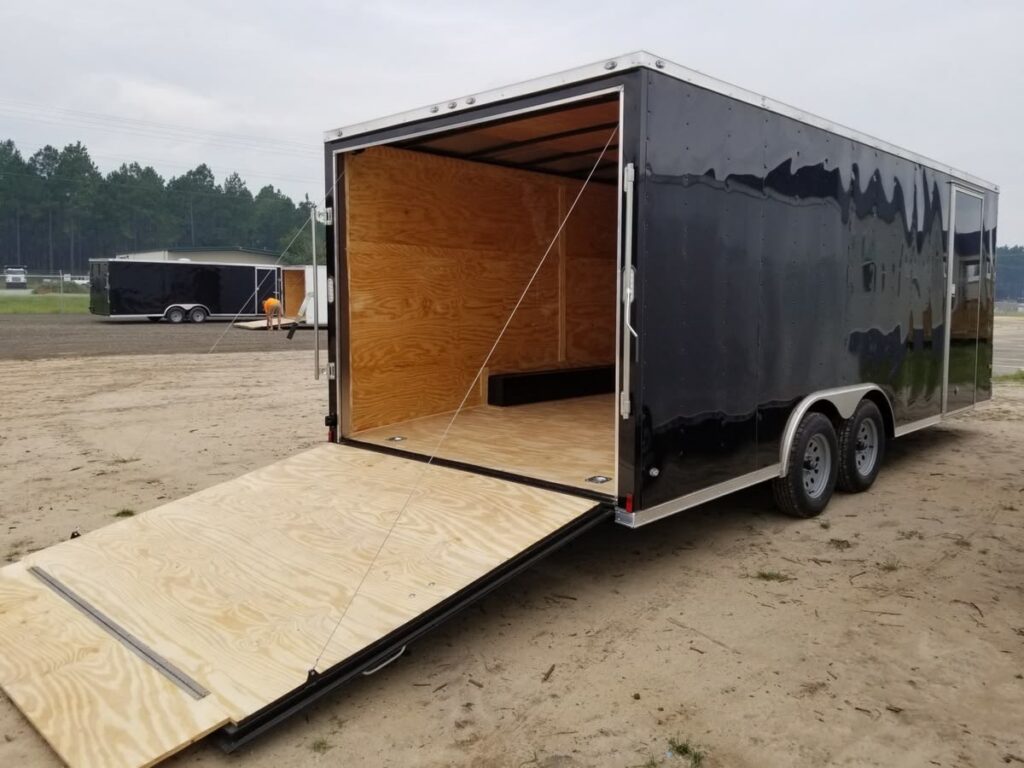
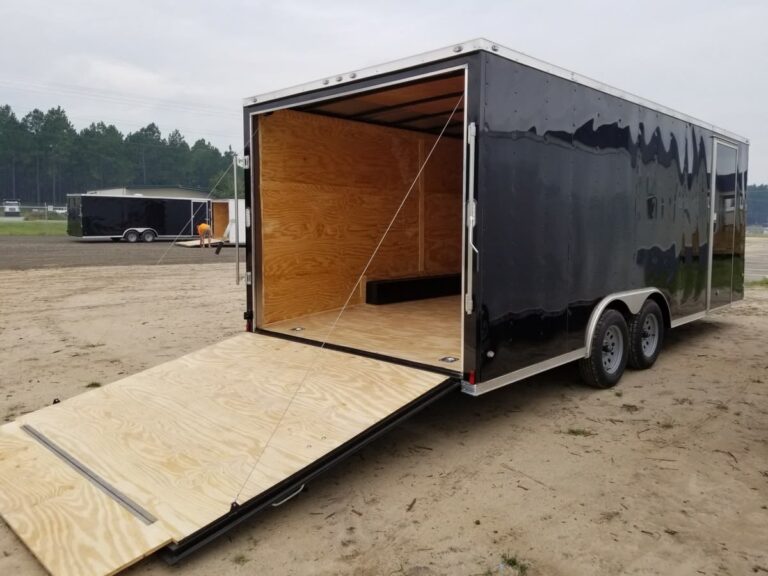
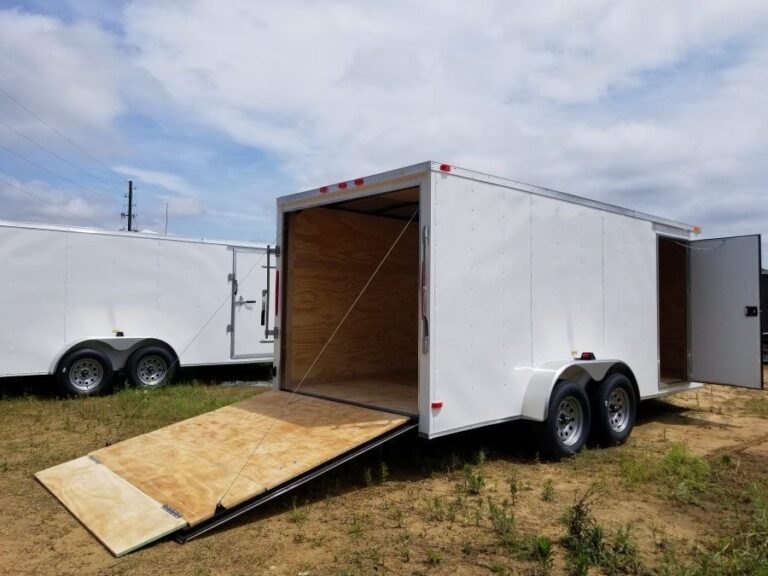
A ramp door is a rear trailer door that folds downward to create a loading ramp.
When opened, the ramp provides a continuous path between the ground and the trailer floor.
This makes ramp doors particularly useful for wheeled equipment such as:
- Lawn mowers
- Motorcycles
- ATVs
- UTVs
- Carts
- Hand trucks
- Equipment dollies
The ramp eliminates the need to lift or carry certain equipment over the trailer’s rear threshold.
However, the ramp itself becomes part of the loading system, so its construction and weight capacity need to be considered.
What Are Barn Doors?
Barn doors are rear swing-out doors that open outward from the trailer.
Instead of creating a ramp, they provide a vertical opening into the trailer.
Barn doors can be useful when cargo is:
- Hand-loaded
- Boxed
- Palletized
- Loaded with a dolly
- Loaded using a forklift
- Moved with other equipment
Because the doors swing outward, you need sufficient clearance behind the trailer.
Ramp Door vs. Barn Doors at a Glance
Feature | Ramp Door | Barn Doors |
|---|---|---|
Loading wheeled equipment | Excellent | Usually requires separate ramp |
Boxed cargo | Good | Excellent |
Ground clearance needed | Ramp extends outward | Doors swing outward |
Forklift access | Depends on ramp design | Often convenient with appropriate setup |
Loading angle | Requires ramp | Direct trailer-floor access |
Rear opening | Large | Large |
Door weight | Generally heavier | Generally lighter |
Maintenance | More moving components | Simpler door mechanism |
Space behind trailer | Ramp requires clearance | Doors require swing clearance |
Best for | Wheeled equipment | General cargo and palletized loads |
The right choice depends on your cargo and loading method.
Loading Wheeled Equipment
This is where ramp doors have a major advantage.
Suppose you need to load:
- A riding mower
- Motorcycle
- ATV
- Small equipment
- Heavy tool carts
With a ramp door, you can generally drive or roll the equipment directly into the trailer.
With barn doors, you may need:
- A portable ramp
- Loading equipment
- A forklift
- Another method of bridging the trailer floor
For buyers regularly hauling wheeled equipment, the ramp can make loading much easier.
If you frequently transport landscaping equipment, you may also want to compare an enclosed trailer with Utility Trailers, particularly when weather protection isn’t essential.
Loading Boxes and General Cargo
Barn doors can be particularly convenient for boxed or loose cargo.
For example, if you’re transporting:
- Boxes
- Furniture
- Supplies
- Inventory
- Building materials
- Tools
you can open both rear doors and access the full width of the rear opening.
A hand truck or pallet jack may be easier to maneuver through a barn-door configuration, depending on the trailer floor height and loading environment.
Accessibility
Door design can affect how easily you can access the cargo.
A ramp creates a gradual transition between the ground and trailer floor.
That can be useful for wheeled equipment.
Barn doors provide direct access to the rear of the trailer, but the trailer floor remains elevated above ground level.
For frequent loading and unloading, consider which configuration will reduce the amount of lifting and handling required.
Door Opening Size
Don’t only look at the outside dimensions of the trailer.
Check the actual door opening dimensions.
Important measurements include:
- Door width
- Door height
- Floor height
- Ramp length
- Ramp angle
- Interior height
A trailer can be large enough internally but still have an opening that is too small for your equipment.
This is particularly important for tall equipment.
For broader size planning, see Enclosed Cargo Trailer Sizes: How to Choose the Right Size.
Ramp Capacity
If you’re choosing a ramp door, pay attention to its load capacity.
The ramp may need to support:
- Equipment
- Operator
- Additional cargo
- Wheels concentrated in particular areas
Don’t assume that the trailer’s overall GVWR automatically represents the ramp’s individual capacity.
The ramp should be used according to the manufacturer’s specifications.
This is especially important for heavy equipment.
Loading With a Forklift
Barn doors can be useful for certain commercial loading operations because they can provide a wide rear opening.
However, whether a forklift can safely load a particular enclosed trailer depends on:
- Floor construction
- Floor capacity
- Trailer design
- Door opening
- Forklift size
- Loading surface
- Manufacturer specifications
Never assume that an enclosed trailer floor is automatically designed for forklift loading.
If your business regularly moves palletized or heavy equipment, verify the manufacturer’s specifications before purchasing.
Security Considerations
Both door configurations can be secured.
Depending on the trailer, security features may include:
- Lockable latches
- Door locks
- Exterior locks
- Interior locking systems
- Security hardware
The important thing is to consider what you are carrying.
If you’re transporting expensive tools or inventory, security should be part of your trailer selection process rather than an afterthought.
Space Around the Trailer
The amount of space available at your loading location also matters.
Ramp Door
A ramp extends behind the trailer.
You’ll need enough room for the ramp to fully deploy and for equipment to move safely up and down it.
Barn Doors
Barn doors swing outward.
You’ll need enough space behind the trailer for the doors to open completely.
This can matter when loading in:
- Garages
- Narrow driveways
- Loading areas
- Warehouses
- Crowded job sites
Measure your typical loading environment before choosing.
Ramp Door Maintenance
Ramp doors have several components that require attention.
Depending on the design, these may include:
- Hinges
- Cables
- Springs
- Latches
- Ramp supports
- Seals
- Flooring
Inspect the ramp regularly.
Look for:
- Loose hardware
- Damaged hinges
- Worn cables
- Damaged seals
- Cracked flooring
- Excessive movement
A damaged ramp should not be used until it has been properly inspected and repaired.
Barn Door Maintenance
Barn doors generally have a simpler opening mechanism, but they still need regular inspection.
Check:
- Hinges
- Latches
- Door seals
- Locking mechanisms
- Door alignment
- Hardware
If the doors become difficult to close or no longer seal properly, investigate the cause.
Water intrusion around the rear doors can eventually damage the trailer’s interior.
Weather Protection
Both door styles can provide good weather protection when properly designed and maintained.
The key factors include:
- Door seals
- Roof condition
- Exterior panels
- Door alignment
- Floor condition
- Drainage
An enclosed trailer protects cargo from direct exposure to rain and road debris, but it isn’t automatically waterproof forever.
Regularly inspect the seals and roof.
Weight and Payload Considerations
A ramp door can add more weight than a basic pair of barn doors because of the ramp structure and hardware.
That additional weight becomes part of the trailer’s overall weight.
Remember:
Payload = GVWR − Empty Trailer Weight
If you add a heavier door, shelving, cabinets, or other accessories, the empty weight increases.
Our Enclosed Cargo Trailer GVWR & Payload: Complete Weight Guide explains how these ratings work and why accessories should be included when calculating available payload.
Best Door for Contractors
Contractors should start with the equipment they carry.
Ramp door may be useful for:
- Tool carts
- Small equipment
- Wheeled machines
- Motorized equipment
Barn doors may be useful for:
- Boxes
- Building supplies
- Tools
- Palletized cargo
- Hand-loaded materials
If you carry a mixture of both, a trailer configuration that provides multiple access options may be worth considering.
Best Door for Landscapers
Landscapers frequently transport wheeled equipment.
For example:
- Zero-turn mowers
- Push mowers
- Edgers
- Blowers
- Carts
A ramp door can simplify loading and unloading.
However, payload remains critical.
A trailer needs sufficient capacity for the combined weight of the equipment, fuel or supplies where applicable, tools, and accessories.
If you’re primarily hauling landscaping equipment and don’t require an enclosed space, Utility Trailers may also be worth comparing.
Best Door for Businesses
Businesses often need quick and organized access to inventory.
Barn doors can be useful for:
- Boxes
- Shelving
- Delivery items
- Inventory
- Equipment
A side access door can also be valuable because you don’t always need to open the entire rear of the trailer to retrieve a small item.
When choosing your trailer, consider the complete door configuration, not just the rear door.
Best Door for Recreational Equipment
Recreational users may transport:
- Motorcycles
- ATVs
- Bicycles
- Camping equipment
- Sports equipment
If you’re regularly driving or rolling equipment into the trailer, a ramp door can be especially convenient.
If you’re mainly carrying boxes and smaller gear, barn doors may provide all the access you need.
Can You Have Both?
Some enclosed trailers can be configured with multiple access points.
For example, a trailer may have:
- Rear ramp door
- Side entry door
- Additional access door
This can provide flexibility.
You can use the ramp for equipment and the side door for quick access to tools or smaller cargo.
However, additional doors and hardware can increase:
- Trailer weight
- Cost
- Maintenance requirements
Make sure the added functionality is actually useful for your application.
How Trailer Size Affects Door Choice
Door selection should always be considered alongside trailer dimensions.
For example, a compact 5×8 trailer may be used differently from a larger 7×16 trailer.
If you’re comparing specific sizes, see:
5×8 Enclosed Cargo Trailer Buying Guide: How to Choose the Right Compact Trailer
5×10 Enclosed Cargo Trailer Buying Guide: Size, Capacity & Features
6×12 Enclosed Cargo Trailer Buying Guide: Size, Capacity & Features
7×14 Enclosed Cargo Trailer Buying Guide: How to Choose the Right Trailer
7×16 Enclosed Cargo Trailer Buying Guide: How to Choose the Right Trailer
The correct door configuration depends partly on what those dimensions allow you to load.
Ramp Door vs. Barn Doors by Application
Application | Ramp Door | Barn Doors |
|---|---|---|
Lawn mowers | Excellent | Requires additional loading method |
Motorcycles | Excellent | Requires ramp |
ATVs/UTVs | Excellent | Requires ramp |
Toolboxes | Good | Excellent |
Boxes | Good | Excellent |
Palletized cargo | Depends on floor/ramp | Often convenient |
Construction supplies | Good | Good |
Mobile workshop | Excellent | Excellent |
General cargo | Excellent | Excellent |
Frequent equipment loading | Excellent | Less convenient without a ramp |
What About Other Trailer Categories?
Door configuration is important, but the type of trailer should match the job first.
If you need to transport loose materials and unload them quickly, Dump Trailers may be more appropriate than an enclosed cargo trailer.
If you’re transporting wide equipment and need an open deck, Deck-Over Trailers provide a different loading configuration.
For lower open-deck equipment hauling, Lowdeck Trailers may also be worth considering.
And if you’re transporting horses or livestock, Horse & Stock Trailers are designed specifically around those hauling requirements.
How to Choose the Right Door
Before buying, ask yourself:
1. What are you loading?
Wheeled equipment generally favors ramp access.
2. How heavy is it?
Make sure the ramp and trailer are rated appropriately.
3. How often will you load?
Frequent loading makes convenience more important.
4. Where will you load?
Consider available space behind the trailer.
5. Do you need quick access to small items?
A side door can be valuable.
6. Do you need pallet or forklift access?
Check the floor and door specifications before assuming the trailer is suitable.
Buying Checklist
Before selecting your enclosed trailer door configuration, check:
- ☐ Rear door type
- ☐ Door opening width
- ☐ Door opening height
- ☐ Ramp capacity
- ☐ Ramp length
- ☐ Floor height
- ☐ Interior height
- ☐ Door seals
- ☐ Door hardware
- ☐ Locking system
- ☐ Available loading space
- ☐ Cargo dimensions
- ☐ Cargo weight
- ☐ Trailer GVWR
- ☐ Trailer payload
- ☐ Tow vehicle capacity
Frequently Asked Questions
Is a ramp door better than barn doors?
Neither is universally better. A ramp door is particularly convenient for wheeled equipment, while barn doors can be convenient for boxed, palletized, or hand-loaded cargo.
Can you load a motorcycle through barn doors?
Yes, but you generally need an appropriate ramp or loading system because barn doors don’t create a ramp themselves.
Are ramp doors heavier?
They can be because the ramp and supporting hardware add additional weight. Check the actual trailer’s empty weight and specifications.
Can a forklift load an enclosed trailer?
Some trailers may be designed for particular loading methods, but you should never assume that a trailer floor can support forklift loading. Check the manufacturer’s specifications.
Do barn doors provide a wider opening?
They can provide a wide rear opening, but the exact opening depends on the trailer’s design and door dimensions.
Do ramp doors affect payload?
The ramp and its hardware contribute to the trailer’s empty weight, which affects the remaining payload capacity.
Can an enclosed trailer have both a ramp and side door?
Yes, some configurations can include multiple access doors. Availability depends on the trailer manufacturer and model.
Final Thoughts
Choosing between a ramp door and barn doors comes down primarily to how you load and unload your trailer.
If you’re regularly transporting mowers, motorcycles, ATVs, UTVs, carts, or other wheeled equipment, a ramp door can make the loading process much easier.
If you’re primarily moving boxes, inventory, tools, supplies, or palletized cargo, barn doors can provide straightforward rear access without the additional weight and hardware of a full ramp.
And if your operation involves different types of cargo, consider whether a trailer with multiple access points would provide greater flexibility.
Before making your decision, compare:
- Cargo type
- Cargo weight
- Door opening dimensions
- Ramp capacity
- Interior dimensions
- GVWR
- Payload
- Tow vehicle capability
- Available loading space
- Frequency of use
For the complete buying process, start with Enclosed Cargo Trailer Buying Guide: How to Choose the Right Trailer for Secure Transport.
If you’re comparing trailer dimensions, read Enclosed Cargo Trailer Sizes: How to Choose the Right Size.
For weight capacity, see Enclosed Cargo Trailer GVWR & Payload: Complete Weight Guide.
And when you’re ready to browse available models, visit Enclosed Cargo Trailers.
The best trailer door is the one that makes your actual loading process easier. Choose the door configuration around the equipment and cargo you move most often—not simply around the way the trailer looks.
For open-deck equipment hauling, Utility Trailers provide a different configuration. For wide equipment, Deck-Over Trailers may be worth considering. And for horses or livestock, Horse & Stock Trailers are designed specifically for that type of transportation.
For safe towing and loading practices, visit the NHTSA trailer safety guidelines.
