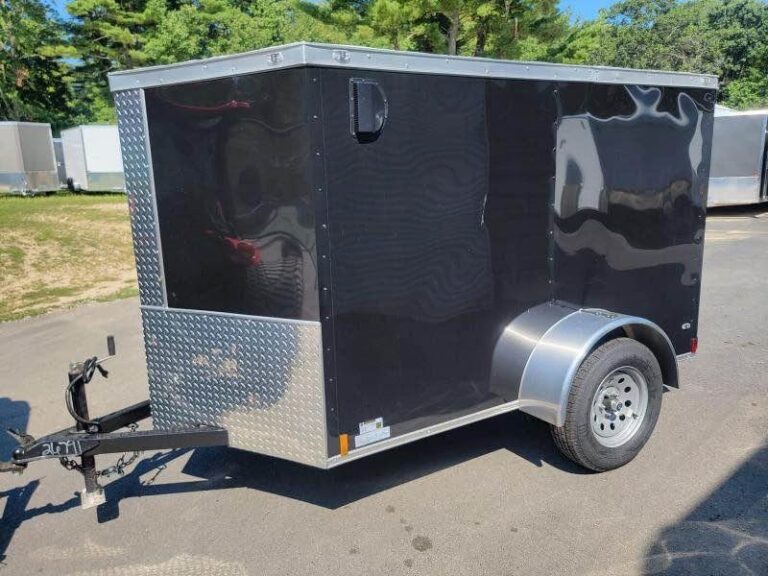

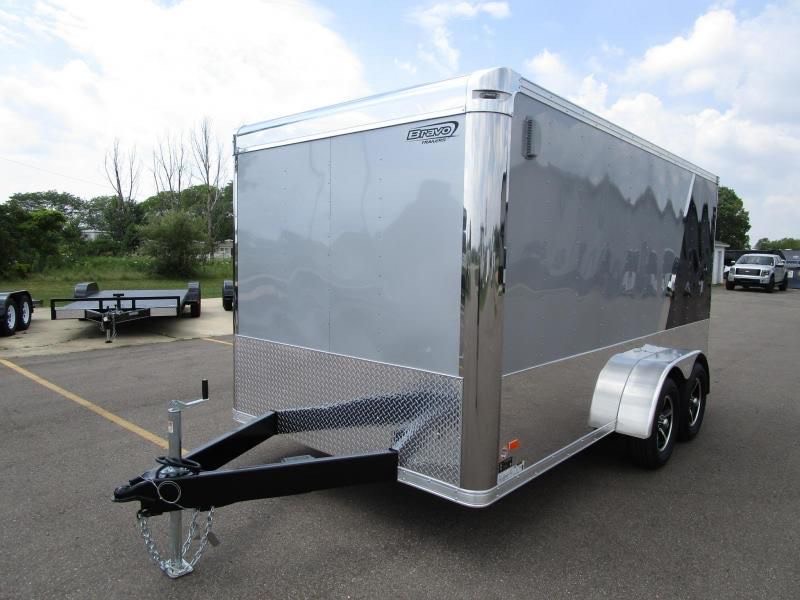
A 7×16 enclosed cargo trailer is designed for buyers who need substantially more enclosed cargo space than compact trailers such as a 5×8, 5×10, or 6×12.
With approximately 7 feet of width and 16 feet of length, this configuration can provide room for larger equipment, multiple pieces of machinery, business inventory, motorcycles, landscaping equipment, tools, and other cargo that requires additional floor space.
However, choosing a 7×16 trailer involves more than simply looking at its dimensions.
You should also consider:
- Interior dimensions
- Door opening
- Interior height
- GVWR
- Payload
- Axle configuration
- Tires
- Brakes
- Tow vehicle
- Cargo securement
- Storage space
- Intended use
For the complete buying process, start with Enclosed Cargo Trailer Buying Guide: How to Choose the Right Trailer for Secure Transport.
If you’re unfamiliar with enclosed cargo trailers, see What Is an Enclosed Cargo Trailer? Complete Guide for Buyers.
You can also compare different trailer sizes in Enclosed Cargo Trailer Sizes: How to Choose the Right Size.
What Is a 7×16 Enclosed Cargo Trailer?
A 7×16 enclosed cargo trailer generally refers to an enclosed trailer with approximately:
- 7 feet of interior width
- 16 feet of interior length
The actual interior dimensions can vary depending on the manufacturer, wall construction, floor design, and configuration.
A typical enclosed cargo trailer includes:
- Frame
- Floor
- Walls
- Roof
- Axle or axles
- Suspension
- Wheels and tires
- Coupler
- Rear door
- Exterior lighting
Depending on the model, you may also find:
- Ramp door
- Side entry door
- V-nose
- D-rings
- E-track
- Interior lighting
- Shelving
- Cabinets
- Roof vent
- Spare tire
Always compare the manufacturer’s actual specifications before purchasing.
How Much Space Does a 7×16 Trailer Have?
A nominal 7×16 trailer provides approximately 112 square feet of floor area.
That makes it considerably larger than a 7×14.
Trailer Size | Approx. Nominal Floor Area |
|---|---|
5×8 | 40 sq. ft. |
5×10 | 50 sq. ft. |
6×12 | 72 sq. ft. |
7×14 | 98 sq. ft. |
7×16 | 112 sq. ft. |
8.5×20 | 170 sq. ft. |
These are nominal calculations.
Actual usable space can be smaller because of:
- Interior wall thickness
- Wheel wells
- Doors
- Cabinets
- Shelving
- Other interior equipment
The extra two feet of length compared with a 7×14 can be useful for longer equipment or for creating more separation between cargo.
What Can You Haul in a 7×16 Enclosed Trailer?
A 7×16 can accommodate a broad range of cargo, depending on its configuration and weight rating.
Potential applications include:
- Contractor equipment
- Construction tools
- Landscaping equipment
- Lawn-care equipment
- Motorcycles
- Recreational equipment
- Business inventory
- Event equipment
- Building supplies
- Small machinery
- Boxes and supplies
The additional length can also help when transporting equipment that would be difficult to fit into shorter trailers.
However, floor space and payload capacity are separate considerations.
A trailer can have plenty of room but still have insufficient payload for heavy equipment.
7×16 Trailer Dimensions Explained
Before buying, look beyond the advertised 7×16 dimensions.
Pay attention to:
Measurement | Why It Matters |
|---|---|
Interior length | Determines front-to-back cargo space |
Interior width | Determines side-to-side clearance |
Interior height | Determines vertical clearance |
Rear door width | Determines what can enter |
Rear door height | Important for tall equipment |
Ramp width | Important for wheeled equipment |
Floor height | Affects loading |
Wheel-well clearance | Can reduce usable floor are |
For example, an equipment manufacturer may advertise a machine as 6 feet wide.
That does not automatically mean it will comfortably fit inside every 7-foot trailer.
Measure the equipment and compare it with the actual usable interior width and door opening.
Understanding GVWR and Payload
One of the most important specifications is the trailer’s GVWR, or Gross Vehicle Weight Rating.
GVWR represents the maximum loaded weight rating of the trailer.
A simplified calculation is:
Payload = GVWR − Empty Trailer Weight
For example:
- GVWR: 7,000 lbs
- Empty trailer weight: 3,000 lbs
The theoretical remaining capacity would be:
7,000 − 3,000 = 4,000 lbs
This is only an example.
Actual payload varies by trailer.
Before loading, account for:
- Cargo
- Shelving
- Cabinets
- Spare tires
- Toolboxes
- Other installed equipment
Also check the ratings of the:
- Axles
- Tires
- Wheels
- Coupler
- Brakes
Never assume that every 7×16 trailer has the same GVWR or payload.
Axle Configuration
A 7×16 enclosed trailer is generally a larger configuration, so axle capacity becomes particularly important.
Depending on the model, you may encounter different axle configurations.
Single Axle
A single axle can provide:
- Simpler design
- Easier maneuverability
- Potentially lower empty weight
- Suitability for lighter applications
Tandem Axle
Tandem axles can provide:
- Greater capacity in applicable configurations
- Additional stability
- Better support for certain heavier loads
- Different braking requirements
The number of axles is only one part of the equation.
Always compare the complete trailer rating, including GVWR, axle capacity, tire rating, and braking system.
Important 7×16 Trailer Features
A larger enclosed trailer can benefit from features that improve loading and organization.
Ramp Door
A ramp door can simplify loading:
- Motorcycles
- Lawn equipment
- Carts
- Wheeled machinery
- Small equipment
Side Entry Door
A side door provides convenient access to the interior without opening the rear.
This can be especially useful when the trailer is packed with equipment.
Interior Lighting
A longer trailer has a deeper interior, making adequate lighting useful when working inside.
D-Rings
D-rings provide designated points for appropriate cargo securement.
E-Track
E-track can provide adjustable tie-down positions and allow you to change your cargo arrangement.
Shelving
Shelving can help organize smaller equipment and supplies.
However, shelving also consumes space and adds weight.
Cabinets
Cabinets can keep tools and smaller items organized.
Again, account for their weight when calculating your loaded trailer weight.
Ramp Door vs. Barn Doors
The right rear-door configuration depends heavily on your cargo.
Ramp Door
A ramp is particularly useful for:
- Motorcycles
- Lawn equipment
- Carts
- Wheeled tools
- Small machinery
Barn Doors
Barn doors can be convenient for:
- Boxes
- Tools
- Supplies
- Business inventory
- Hand-loaded cargo
If you frequently roll equipment into your trailer, a ramp can make loading considerably easier.
If most of your cargo is hand-loaded, barn doors may be sufficient.
7×16 Enclosed Trailer for Contractors
A 7×16 can provide substantial enclosed storage for contractors.
Potential cargo includes:
- Power tools
- Hand tools
- Ladders
- Building materials
- Extension cords
- Safety equipment
- Fasteners
- Job-site supplies
- Small machinery
The additional length can allow contractors to create separate areas inside the trailer.
For example:
Front section: Shelving and tool storage
Middle: Equipment
Rear: Frequently accessed supplies
A properly organized trailer can function as both transportation and mobile storage.
7×16 Enclosed Trailer for Landscaping
A 7×16 can provide considerable space for landscaping businesses.
Depending on equipment dimensions and trailer ratings, it can potentially accommodate:
- Lawn-care equipment
- Trimmers
- Blowers
- Hand tools
- Landscaping supplies
- Compact machinery
Before buying, measure equipment with attachments installed.
Also consider:
- Door opening
- Ramp dimensions
- Equipment height
- Equipment width
- Equipment weight
- Tie-down locations
If you regularly transport extremely wide equipment, an open configuration may provide easier loading. Explore Utility Trailers for open-deck applications.
7×16 Enclosed Trailer for Equipment Transportation
One major advantage of a 7×16 is the ability to transport more equipment in one trip.
The additional length can be particularly useful for:
- Long tools
- Multiple machines
- Motorcycles
- Commercial equipment
- Large quantities of supplies
However, loading more equipment also increases the importance of weight distribution.
Don’t simply load cargo wherever there is available space.
Distribute cargo appropriately and secure it according to the trailer and cargo manufacturer’s recommendations.
7×16 Enclosed Trailer for Motorcycles
The size of a 7×16 can provide considerable flexibility for motorcycle transportation.
Depending on the motorcycles and trailer configuration, you may have room for multiple bikes or additional equipment.
Measure:
- Overall length
- Width
- Handlebar width
- Height
- Wheelbase
Then compare those measurements with:
- Interior dimensions
- Rear-door opening
- Ramp width
Also leave adequate room for proper cargo securement.
Never exceed the trailer’s payload rating.
7×16 Enclosed Trailer for Small Businesses
Businesses that need substantial mobile storage can use a 7×16 as a transportation and inventory solution.
Potential applications include:
- Event businesses
- Mobile service companies
- Contractors
- Equipment businesses
- Delivery operations
- Retail inventory
- Trade-show equipment
A 7×16 can also accommodate organized storage systems such as:
- Shelving
- Cabinets
- Tool racks
- Workbenches
- E-track
Just remember that every modification adds weight and can reduce available payload.
7×16 vs. 7×14 Enclosed Trailer
The 7×16 provides two additional feet of length compared with a 7×14.
Feature | 7×14 | 7×16 |
|---|---|---|
Nominal width | 7 ft | 7 ft |
Nominal length | 14 ft | 16 ft |
Approx. floor area | 98 sq. ft. | 112 sq. ft. |
Cargo length | Good | Greater |
Storage | More compact | More space |
Maneuverability | Easier | More demanding |
Parking footprint | Smaller | Larger |
Potential towing requirements | Lower in some configurations | Higher in some configurations |
If your 7×14 is consistently full or you’re transporting longer equipment, the extra two feet can be useful.
For the smaller configuration, see 7×14 Enclosed Cargo Trailer Buying Guide: How to Choose the Right Trailer.
7×16 vs. 8.5-Foot-Wide Enclosed Trailers
One important decision is whether you need a 7-foot-wide trailer or a wider 8.5-foot configuration.
A wider trailer can provide additional side-to-side space.
Feature | 7×16 | 8.5-Foot-Wide Trailer |
|---|---|---|
Width | Approx. 7 ft | Approx. 8.5 ft |
Maneuverability | More compact | More demanding |
Side-by-side cargo | Good | Greater flexibility |
Road footprint | Smaller | Wider |
Storage requirements | Lower | Higher |
Large equipment | Good | More room |
If width is the main limitation with your current trailer, moving to a wider configuration may make more sense than simply adding length.
7×16 Enclosed Trailer vs. Utility Trailer
A 7×16 enclosed trailer and an open utility trailer are designed around different priorities.
Feature | 7×16 Enclosed | Utility Trailer |
|---|---|---|
Weather protection | High | Limited |
Cargo security | Greater potential | More exposed |
Side access | Limited | Excellent |
Oversized cargo | More restricted | Easier |
Interior storage | Yes | No |
Cargo visibility | Low | High |
Tool organization | Excellent potential | Limited |
Equipment protection | Greater | Lower |
If protecting tools, equipment, and inventory from weather is important, an enclosed trailer can be useful.
If you regularly haul oversized or unusually shaped equipment, an open trailer may provide greater flexibility.
Choosing the Right Tow Vehicle
A 7×16 can represent a significant towing load, particularly when fully loaded.
Before purchasing, verify:
- Vehicle tow rating
- Vehicle payload rating
- Hitch rating
- Tongue-weight limit
- Trailer GVWR
- Trailer empty weight
- Expected cargo weight
Your calculation should be based on the loaded trailer, not simply the empty trailer.
Also consider how additional equipment such as shelving, cabinets, spare tires, and workbenches affects the total weight.
New vs. Used 7×16 Enclosed Trailer
A new trailer lets you select the exact configuration and features you need.
If considering a used 7×16, perform a detailed inspection.
Frame
Look for:
- Cracks
- Significant corrosion
- Bent sections
- Evidence of structural repairs
Floor
Check for:
- Soft areas
- Rot
- Cracks
- Water damage
Roof
Inspect for:
- Leaks
- Damage
- Improper repairs
Doors
Check:
- Hinges
- Latches
- Seals
- Alignment
Tires and Running Gear
Inspect:
- Tread
- Sidewalls
- Tire age
- Wheels
- Axles
- Suspension
- Bearings
Electrical System
Test:
- Brake lights
- Turn signals
- Running lights
- Wiring
- Connector
7×16 Enclosed Trailer Maintenance
A larger trailer needs the same basic maintenance attention as smaller trailers, but there are more components to inspect.
Tires
Regularly check:
- Inflation
- Tread
- Sidewalls
- Cracks
- Uneven wear
Bearings
Follow the manufacturer’s inspection and lubrication schedule.
Brakes
Where equipped, inspect and maintain the braking system according to manufacturer recommendations.
Coupler
Check the coupler and locking mechanism before towing.
Safety Chains
Inspect for damage and ensure the appropriate connection is used.
Lights
Test all exterior lights before every trip.
Doors
Inspect:
- Hinges
- Latches
- Seals
- Alignment
Roof
Look for damage and signs of water intrusion.
Floor
Inspect for:
- Soft spots
- Moisture damage
- Cracks
- Deterioration
Cargo Securement
Before towing, ensure cargo is appropriately secured and distributed.
For additional general load-security information, see the National Highway Traffic Safety Administration’s Secure Your Load guidance.
7×16 Enclosed Trailer Buying Checklist
Category | What to Check |
|---|---|
Interior length | Is 16 ft enough? |
Interior width | Is 7 ft sufficient? |
Interior height | Will equipment fit vertically? |
Door opening | Can the largest cargo enter? |
GVWR | What is the maximum loaded rating? |
Payload | Is there enough capacity for your cargo? |
Axles | What configuration is appropriate? |
Tires | Are they correctly rated? |
Brakes | Is the braking configuration appropriate? |
Ramp | Do you need one? |
Side door | Would it improve access? |
Tie-downs | Are adequate securement points available? |
Storage | Do you have sufficient parking space? |
Tow vehicle | Can it safely tow the loaded trailer? |
Future needs | Will it accommodate your expected workload? |
Frequently Asked Questions
Is a 7×16 enclosed trailer a good size?
A 7×16 provides substantial enclosed cargo space and can be useful for contractors, landscapers, businesses, equipment owners, and recreational users.
How much can a 7×16 enclosed trailer carry?
There is no universal payload capacity. Check the specific trailer’s GVWR, empty weight, axle rating, tire rating, and other specifications.
Is a 7×16 bigger than a 7×14?
Yes. Both have the same nominal width, but the 7×16 is two feet longer and provides approximately 14 additional square feet of nominal floor area.
Can a 7×16 carry motorcycles?
It can provide substantial space for motorcycles, but the number and type of motorcycles you can transport depend on their dimensions and the trailer’s payload rating.
Is a 7×16 good for contractors?
Yes, it can provide substantial enclosed storage for tools, equipment, supplies, and job-site materials.
Should I choose a ramp door or barn doors?
Choose based on how you load. A ramp is particularly useful for wheeled equipment, while barn doors can be convenient for hand-loaded cargo.
Is a 7×16 difficult to tow?
Towing requirements depend on the actual trailer weight, GVWR, cargo, and vehicle. Always compare the loaded trailer with the tow vehicle’s certified ratings.
Is a 7×16 better than a 7×14?
The 7×16 provides more length and floor space. The 7×14 is more compact. The appropriate size depends on your cargo and towing requirements.