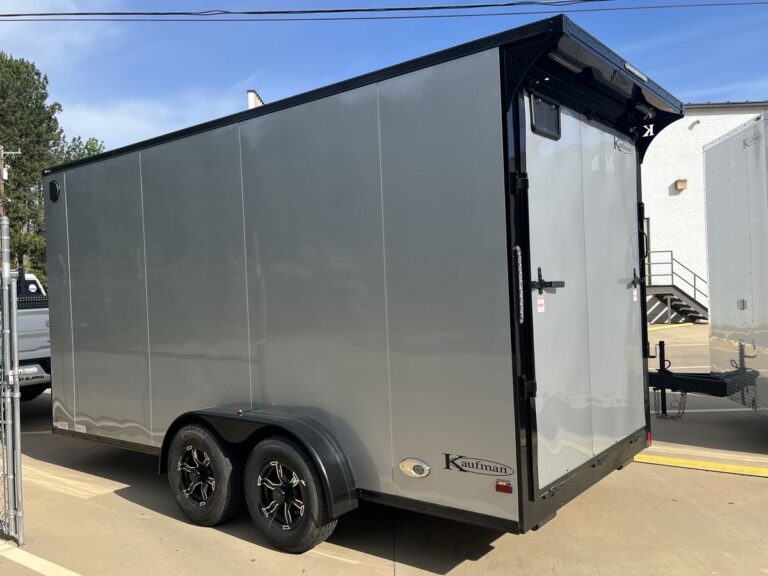

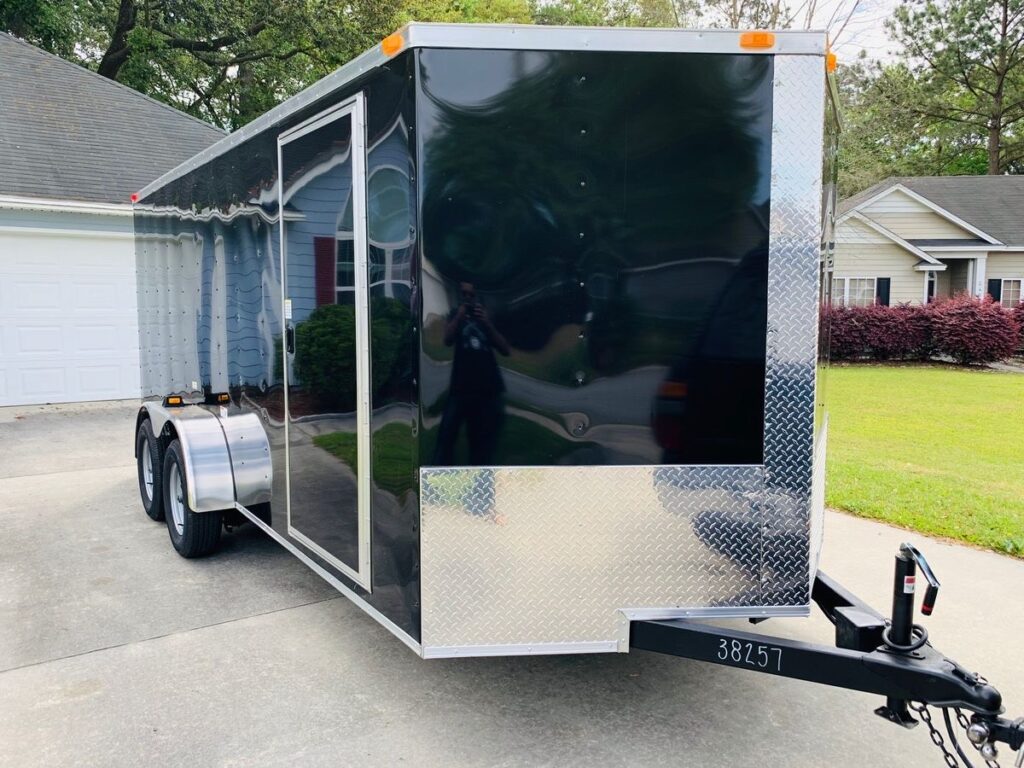
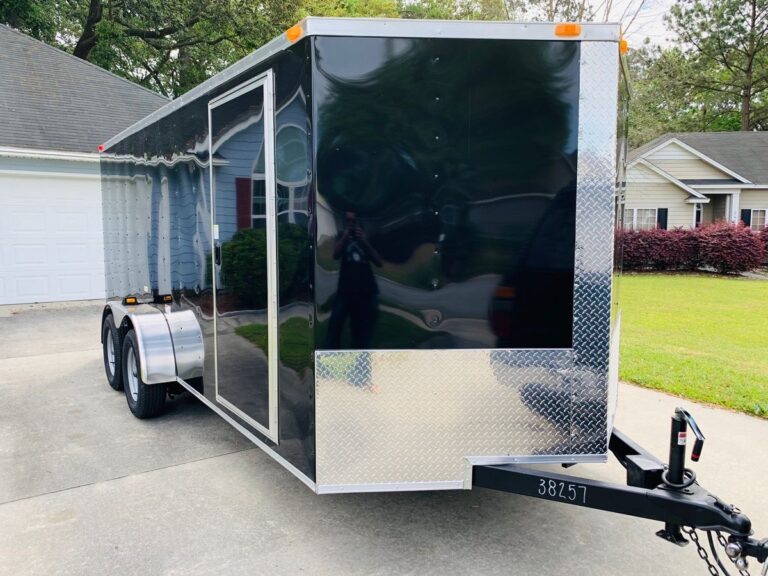
A 7×14 enclosed cargo trailer is a substantial step up from compact enclosed trailers such as the 5×8, 5×10, and 6×12.
With approximately 7 feet of width and 14 feet of length, this configuration provides significantly more floor space for contractors, landscapers, businesses, equipment owners, and buyers who need to transport larger or multiple items while keeping their cargo enclosed.
The extra space can be useful, but a larger trailer also means you need to pay closer attention to GVWR, payload, axle configuration, towing capacity, door dimensions, and storage requirements.
If you’re still comparing sizes, start with Enclosed Cargo Trailer Buying Guide: How to Choose the Right Trailer for Secure Transport.
For an overview of how enclosed trailers work, see What Is an Enclosed Cargo Trailer? Complete Guide for Buyers.
You can also compare common dimensions in Enclosed Cargo Trailer Sizes: How to Choose the Right Size.
What Is a 7×14 Enclosed Cargo Trailer?
A 7×14 enclosed cargo trailer generally refers to a trailer with approximately:
- 7 feet of interior width
- 14 feet of interior length
Actual usable dimensions can vary by manufacturer and configuration.
A typical enclosed trailer consists of:
- Frame
- Floor
- Walls
- Roof
- Axle or axles
- Suspension
- Wheels and tires
- Coupler
- Rear doors
- Exterior lighting
Depending on the model, it may also include:
- Ramp door
- Side entry door
- V-nose
- Interior lighting
- D-rings
- E-track
- Shelving
- Cabinets
- Roof vent
- Spare tire
Always verify the manufacturer’s actual dimensions and specifications before purchasing.
How Much Space Does a 7×14 Trailer Have?
A nominal 7×14 trailer provides approximately 98 square feet of floor area.
That’s considerably more space than a 6×12.
Trailer Size | Approx. Nominal Floor Area |
|---|---|
5×8 | 40 sq. ft. |
5×10 | 50 sq. ft. |
6×12 | 72 sq. ft. |
7×14 | 98 sq. ft. |
8.5×20 | 170 sq. ft. |
These calculations are based on nominal dimensions. Actual usable floor space will vary.
Wheel wells, walls, doors, cabinets, and other interior components can reduce usable space.
The additional width is particularly useful when you need to place equipment side by side rather than only extending cargo length.
What Can You Haul in a 7×14 Enclosed Trailer?
A 7×14 can accommodate a broad range of cargo, depending on its specifications.
Potential applications include:
- Contractor equipment
- Landscaping equipment
- Lawn-care equipment
- Construction supplies
- Motorcycles
- Tools
- Business inventory
- Event equipment
- Recreational equipment
- Building materials
- Small machinery
- Boxes and supplies
The larger interior can also make organization easier.
Instead of filling every available space with cargo, you can create designated areas for:
- Tools
- Equipment
- Spare parts
- Supplies
- Tie-down equipment
- Safety equipment
However, the available floor area does not determine how much weight you can carry.
Always check the trailer’s payload capacity.
7×14 Trailer Dimensions Explained
The advertised 7×14 dimensions are only the starting point.
Before buying, examine:
Measurement | Why It Matters |
|---|---|
Interior length | Determines front-to-back cargo capacity |
Interior width | Determines side-by-side clearance |
Interior height | Determines vertical clearance |
Door width | Determines what can enter |
Door height | Important for tall equipment |
Ramp width | Important for wheeled equipment |
Floor height | Affects loading |
Wheel-well clearance | Can affect usable floor space |
For example, if you are transporting a machine that is 6 feet wide, a nominal 7-foot trailer may not necessarily provide 7 feet of usable clearance.
Measure the actual interior.
Understanding GVWR and Payload
GVWR, or Gross Vehicle Weight Rating, is one of the most important specifications when choosing a 7×14.
A simplified calculation is:
Payload = GVWR − Empty Trailer Weight
For example, if a specific trailer has:
- GVWR: 7,000 lbs
- Empty weight: 2,800 lbs
The theoretical remaining capacity would be:
7,000 − 2,800 = 4,200 lbs
This is only an example.
Different 7×14 trailers can have substantially different specifications.
Before loading, consider:
- Trailer GVWR
- Empty trailer weight
- Axle rating
- Tire rating
- Coupler rating
- Brake system
- Cargo weight
- Added shelving and equipment
A larger trailer does not automatically mean unlimited payload.
Single Axle vs. Tandem Axle
At this size, buyers may encounter different axle configurations depending on the trailer’s design and intended load.
Single Axle
A single axle can provide:
- Simpler construction
- Easier maneuverability
- Potentially lower empty weight
- Suitability for lighter applications
Tandem Axle
A tandem configuration can provide:
- Greater capacity in applicable models
- Additional stability
- Better suitability for certain heavier loads
- Different braking requirements
Don’t select based on axle count alone.
Compare the actual GVWR, axle ratings, tire ratings, brakes, and empty weight.
Important 7×14 Trailer Features
The right equipment can make a large enclosed trailer much easier to use.
Ramp Door
A ramp door is especially useful for:
- Motorcycles
- Lawn equipment
- Wheeled machinery
- Carts
- Small equipment
Side Entry Door
A side door gives you access to the trailer without opening the rear.
This is particularly convenient when the trailer is parked close to another object.
Interior Lighting
Larger enclosed trailers can benefit greatly from interior lighting because the deeper cargo area can become difficult to see in low-light conditions.
D-Rings
Properly rated D-rings can provide designated cargo-securement points.
E-Track
E-track can provide adjustable tie-down locations and help organize different cargo configurations.
Shelving and Cabinets
These can be useful for contractors and businesses, although their weight needs to be included in the overall loaded trailer weight.
Roof Ventilation
Roof vents can provide airflow where appropriate.
Ramp Door vs. Barn Doors
The rear door should be selected according to your cargo.
Ramp Door
A ramp is useful when you’re loading:
- Motorcycles
- Lawn equipment
- Carts
- Wheeled tools
- Small machinery
Barn Doors
Barn doors can be convenient when you’re primarily loading:
- Boxes
- Tools
- Supplies
- Inventory
A ramp may be more useful for equipment-heavy applications, while barn doors can work well for hand-loaded cargo.
7×14 Enclosed Trailer for Contractors
The additional floor space of a 7×14 can make it useful for contractors who need to carry both equipment and supplies.
Potential cargo includes:
- Power tools
- Hand tools
- Ladders
- Building supplies
- Safety equipment
- Extension cords
- Job-site materials
- Small machinery
The 14-foot length can allow contractors to create separate areas for different categories of equipment.
For example:
Front: Shelving and smaller tools
Center: Equipment and machinery
Rear: Frequently accessed supplies
Good organization can make the trailer much easier to work from.
7×14 Enclosed Trailer for Landscaping
Landscaping businesses often need to transport a combination of equipment, tools, and supplies.
A 7×14 may provide room for:
- Lawn-care equipment
- Trimmers
- Blowers
- Hand tools
- Landscaping supplies
- Compact machinery
Before buying, measure the equipment with attachments installed.
Don’t forget to consider:
- Equipment height
- Equipment width
- Door opening
- Ramp dimensions
- Equipment weight
If you need to transport especially wide equipment or load from the side, Utility Trailers may offer a more suitable open configuration.
7×14 Enclosed Trailer for Equipment
One of the biggest advantages of a 7×14 is the additional interior floor space.
You can potentially transport multiple pieces of equipment in one trip instead of making several trips with a smaller trailer.
However, organization becomes increasingly important as the trailer gets larger.
Consider using:
- D-rings
- E-track
- Shelving
- Cabinets
- Wall-mounted storage
- Tool racks
Make sure added equipment doesn’t reduce the trailer’s available payload beyond its rated capacity.
7×14 Enclosed Trailer for Small Businesses
A 7×14 can serve as mobile storage and transportation space for businesses that regularly move products or equipment.
Potential applications include:
- Event businesses
- Contractors
- Mobile service businesses
- Equipment rental
- Retail inventory
- Delivery operations
- Trade-show equipment
A larger enclosed trailer can also provide an opportunity for organized inventory storage.
However, remember that shelving, cabinets, flooring, workbenches, and other modifications add weight.
7×14 Enclosed Trailer for Motorcycles
A 7×14 can provide substantial space for motorcycle transportation.
Depending on the motorcycles and trailer configuration, the additional width and length may allow more flexibility when loading.
Measure:
- Motorcycle length
- Motorcycle width
- Handlebar width
- Height
- Wheelbase
Also allow room for:
- Tie-downs
- Ramps
- Riding equipment
- Tools
- Additional cargo
Always confirm the trailer’s payload rating before loading multiple motorcycles.
7×14 vs. 6×12 Enclosed Trailer
The difference between a 6×12 and a 7×14 is significant.
Feature | 6×12 | 7×14 |
|---|---|---|
Nominal width | 6 ft | 7 ft |
Nominal length | 12 ft | 14 ft |
Approx. floor area | 72 sq. ft. | 98 sq. ft. |
Cargo flexibility | Good | Greater |
Side-by-side equipment | More limited | More room |
Storage footprint | Smaller | Larger |
Maneuverability | Easier | More demanding |
Potential towing requirements | Lower in some configurations | Higher in some configurations |
If your 6×12 is consistently full, a 7×14 can provide a meaningful increase in usable space.
See 6×12 Enclosed Cargo Trailer Buying Guide: Size, Capacity & Features for the smaller configuration.
7×14 vs. Larger Enclosed Trailers
Moving beyond a 7×14 can provide even more cargo space, but bigger trailers require more consideration.
A larger trailer may be appropriate if you regularly transport:
- Multiple large machines
- Large quantities of inventory
- Long equipment
- Several motorcycles
- Commercial equipment
However, a larger trailer can also require:
- More towing capacity
- More parking space
- More maneuvering room
- Greater storage space
- More operating weight
Choose a trailer based on your actual workload rather than buying additional space that you rarely use.
7×14 Enclosed Trailer vs. Utility Trailer
Both trailer types have important advantages.
Feature | 7×14 Enclosed | Utility Trailer |
|---|---|---|
Weather protection | High | Limited |
Cargo security | Greater potential | More exposed |
Side loading | Restricted | Easy |
Oversized cargo | More restricted | Easier |
Interior organization | Excellent potential | Limited |
Cargo visibility | Low | High |
Equipment protection | Greater | Lower |
Interior storage | Yes | No |
An enclosed trailer is useful when protecting cargo from weather and exposure is important.
An open utility trailer may be preferable when you’re regularly hauling oversized equipment or need unrestricted access from the sides.
Choosing the Right Tow Vehicle
A 7×14 can be substantially heavier than smaller enclosed trailers, especially when fully loaded.
Before purchasing, verify:
- Vehicle tow rating
- Vehicle payload rating
- Hitch rating
- Tongue-weight rating
- Trailer GVWR
- Trailer empty weight
- Expected cargo weight
Don’t calculate towing requirements using the empty trailer alone.
Your towing setup must account for the loaded trailer.
New vs. Used 7×14 Enclosed Trailer
A new trailer lets you choose the configuration and features that fit your application.
A used trailer can also be considered, but inspection is especially important.
Inspect the Frame
Look for:
- Cracks
- Significant corrosion
- Bent components
- Evidence of major repairs
Inspect the Floor
Look for:
- Soft spots
- Rot
- Cracks
- Water damage
Inspect the Roof
Check for:
- Leaks
- Damage
- Improper repairs
Inspect the Doors
Test:
- Hinges
- Latches
- Seals
- Alignment
Inspect the Running Gear
Check:
- Tires
- Wheels
- Axles
- Suspension
- Bearings
Inspect the Electrical System
Test:
- Brake lights
- Turn signals
- Running lights
- Connector
- Wiring
7×14 Trailer Maintenance
A larger trailer benefits from a consistent maintenance routine.
Tires
Check:
- Pressure
- Tread
- Sidewalls
- Cracks
- Uneven wear
Wheels and Bearings
Follow the manufacturer’s inspection and service recommendations.
Brakes
Where equipped, inspect the braking system according to the manufacturer’s maintenance schedule.
Coupler
Inspect the coupler and locking mechanism before every trip.
Lights
Test all exterior lights before towing.
Doors
Check hinges, latches, seals, and alignment.
Roof
Look for damage and signs of water intrusion.
Floor
Inspect for deterioration, moisture damage, and soft spots.
Cargo Securement
Before every trip, make sure cargo is appropriately secured.
For additional load-securement guidance, the National Highway Traffic Safety Administration’s “Secure Your Load” guidance provides general safety information.
7×14 Enclosed Trailer Buying Checklist
Category | What to Check |
|---|---|
Interior size | Is 7×14 sufficient? |
Interior height | Will your equipment fit? |
Door opening | Can everything enter? |
GVWR | What is the maximum loaded rating? |
Payload | How much cargo can it carry? |
Axles | Single or tandem? |
Tires | Are they appropriately rated? |
Brakes | Does the configuration have suitable brakes? |
Ramp | Do you need one? |
Side door | Would additional access help? |
Tie-downs | Are securement points available? |
Storage | Do you have enough room? |
Tow vehicle | Can it safely tow the loaded trailer? |
Future needs | Will it accommodate your expected growth? |
Frequently Asked Questions
Is a 7×14 enclosed trailer a good size?
A 7×14 provides considerably more floor space than compact enclosed trailers and can be useful for equipment, business inventory, contractors, landscaping, and other applications.
How much weight can a 7×14 enclosed trailer carry?
There is no universal payload rating. Check the specific trailer’s GVWR, empty weight, axle ratings, tires, and other specifications.
Is a 7×14 bigger than a 6×12?
Yes. A nominal 7×14 provides approximately 26 additional square feet of nominal floor area compared with a nominal 6×12.
Can a 7×14 carry motorcycles?
It can provide substantial space for motorcycles, but actual capacity depends on the trailer’s interior dimensions, door opening, payload, and motorcycle dimensions.
Is a 7×14 good for contractors?
It can provide useful enclosed storage for tools, equipment, supplies, and job-site materials.
Is a ramp door necessary?
Not necessarily. A ramp is particularly useful for wheeled equipment, while barn doors may be sufficient for boxes and hand-loaded cargo.
Is a 7×14 harder to tow than a 6×12?
A larger trailer can have greater weight and dimensions, so towing requirements may be higher. Always compare the actual trailer specifications with your vehicle’s ratings.
Should I choose a 7×14 or a utility trailer?
Consider whether you prioritize enclosed cargo protection and security or open access and flexibility for oversized equipment. The appropriate choice depends on the cargo and how you load it.