

Table of Contents
ToggleDump Trailer Dimensions: How to Choose the Right Bed Size for Your Work
Choosing the right dump trailer dimensions is about more than finding the biggest trailer that your truck can tow.
The bed length, width, side-wall height, overall trailer size, payload capacity, and towing requirements all affect how useful the trailer will be for your business.
A landscaping contractor hauling mulch may have different requirements from a construction company transporting concrete debris or gravel. Likewise, a homeowner performing occasional cleanup may not need the same trailer as a contractor using one every day.
In this guide, we’ll explain common dump trailer dimensions and how to choose the right size based on your workload.
What Do Dump Trailer Dimensions Include?
When comparing dump trailers, you’ll typically see measurements describing the dump bed, such as:
- Bed length
- Bed width
- Bed height
- Side-wall height
You should also consider the trailer’s overall dimensions, because the total length and width affect maneuverability, parking, towing, and job-site access.
A trailer’s physical dimensions should always be considered alongside its GVWR and payload capacity.
Why Dump Trailer Bed Size Matters
Bed size determines how much material you can physically fit inside the trailer.
However, volume is not the same as weight capacity.
For example, a trailer may have enough physical space for a large quantity of gravel, but the weight of that gravel could exceed the trailer’s payload rating before the bed is full.
That’s why you should consider:
Dimensions + Volume + Payload + GVWR
rather than dimensions alone.
For more information, see our Dump Trailer Capacity Guide.
5×8 Dump Trailer Dimensions
A 5×8 dump trailer is a compact option that can work well for smaller hauling jobs.
It can be useful for:
- Residential landscaping
- Yard cleanup
- Mulch
- Light debris
- Small gravel loads
- Property maintenance
Its compact footprint can make it easier to maneuver around residential properties.
Learn more with our 5×8 Dump Trailer Buying Guide.
5×10 Dump Trailer Dimensions
A 5×10 dump trailer provides additional bed length compared with a 5×8.
The extra space can be useful for contractors and landscapers who need more room for:
- Mulch
- Soil
- Yard debris
- Gravel
- Construction waste
It can provide a useful balance between capacity and maneuverability.
Read our 5×10 Dump Trailer Buying Guide.
6×10 Dump Trailer Dimensions
A 6×10 dump trailer provides additional width as well as a longer bed.
The extra width can be useful when you need additional volume or are working with larger loads.
Potential applications include:
- Landscaping
- Construction
- Property cleanup
- Gravel hauling
- Soil transportation
- Job-site debris
See our 6×10 Dump Trailer Buying Guide.
How Side-Wall Height Affects Capacity
Bed length and width aren’t the only dimensions that matter.
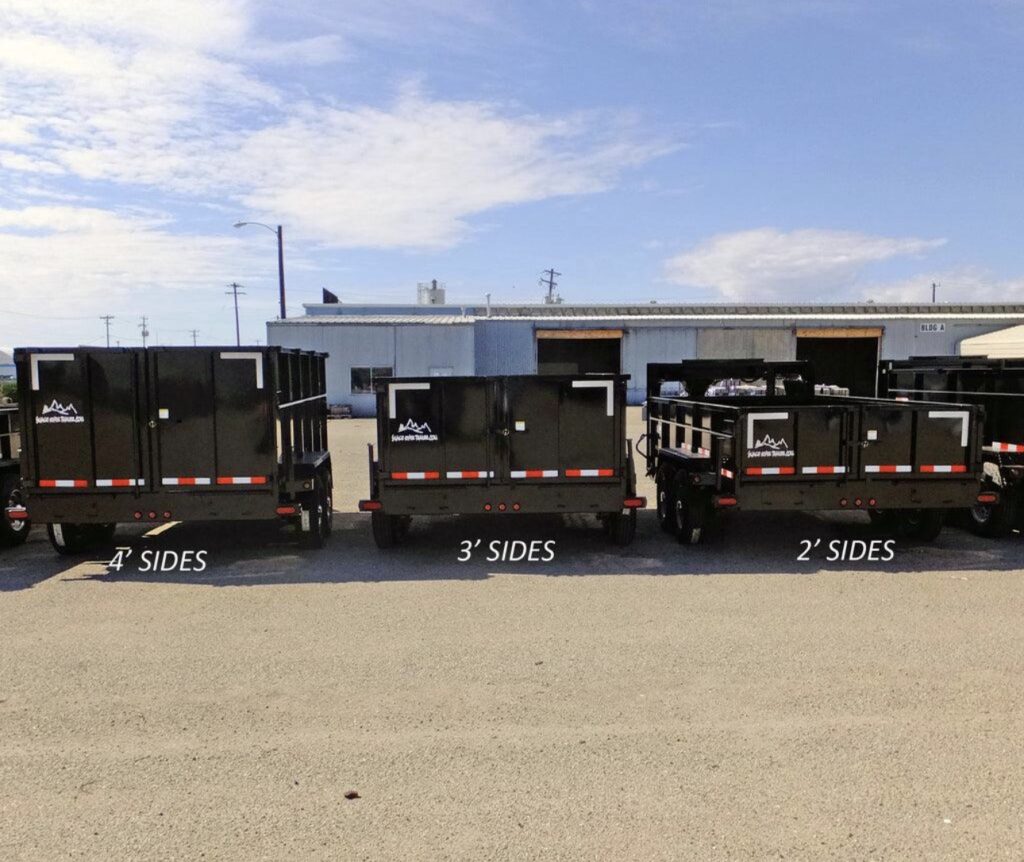
Side-wall height affects the amount of material you can physically contain.
Taller sides can increase the trailer’s potential volume, but that doesn’t mean you should automatically fill the trailer to the top.
For dense materials such as:
- Gravel
- Sand
- Stone
- Concrete
you may reach the trailer’s weight limit well before reaching the top of the side walls.
Dump Trailer Volume vs. Payload
This is one of the most important concepts to understand.
Imagine a dump trailer with a large bed.
You might be able to fit a significant volume of mulch inside it.
But if you fill the same bed with gravel, the load can become much heavier.
Therefore:
Large bed ≠ unlimited payload
Always check the manufacturer’s GVWR and payload specifications before loading.
Choosing Dimensions for Landscaping
Landscapers commonly transport both bulk materials and yard debris.
For smaller residential work
A compact configuration such as a 5×8 Dump Trailer may be sufficient.
For larger landscaping jobs
A 5×10 Dump Trailer or 6×10 Dump Trailer may provide additional space.
The right option depends on your typical load size and tow vehicle.
For a more detailed landscaping guide, see Best Dump Trailer for Landscaping.
Choosing Dimensions for Construction
Construction contractors may need more capacity depending on the materials being transported.
A dump trailer may be used for:
- Dirt
- Gravel
- Sand
- Concrete debris
- Asphalt
- Demolition waste
For smaller residential construction work, a compact trailer may be enough.
For larger workloads, a higher-capacity configuration may be more appropriate.
See our Best Dump Trailer for Construction guide.
Single Axle vs. Tandem Axle Dimensions
Trailer dimensions and axle configuration should be considered together.
Single Axle
Often found on smaller dump trailers and suitable for lighter applications.
Read our Single Axle Dump Trailer Buying Guide.
Tandem Axle
Commonly used on larger and heavier-duty configurations.
Read our Tandem Axle Dump Trailer Buying Guide.
The axle configuration does not by itself determine the trailer’s capacity. Always check the actual specifications.
What About Tri Axle Dump Trailers?
Tri axle dump trailers are designed for applications requiring higher-capacity configurations, depending on the specific trailer.
They may be suitable for:
- Heavy construction
- Commercial hauling
- Excavation
- Demolition
- Large landscaping operations
See our Tri Axle Dump Trailer Buying Guide.
Consider the Overall Trailer Length
The dump bed isn’t the only measurement that matters.
The trailer’s overall length includes components such as the tongue or hitch area.
A longer trailer can affect:
- Turning radius
- Parking
- Storage
- Job-site maneuverability
- Towing characteristics
If you frequently work in tight residential areas, consider the total trailer dimensions rather than looking only at bed size.
Consider Trailer Width
Trailer width is particularly important when working around:
- Narrow driveways
- Residential properties
- Gates
- Job sites
- Storage areas
A wider dump trailer may offer additional bed volume, but a narrower configuration may be easier to maneuver in restricted spaces.
Consider Your Tow Vehicle
Your truck must be capable of handling the trailer’s loaded weight.
Before purchasing, check:
- Maximum towing capacity
- Payload capacity
- Hitch rating
- Tongue-weight rating
- Gross Combined Weight Rating
Don’t assume that a smaller physical trailer is automatically safe for every truck.
The trailer’s actual weight ratings and your vehicle’s ratings must be compatible.
For more information, see our Dump Trailer Weight Limits guide.
Gooseneck Dump Trailer Dimensions
Gooseneck dump trailers can have different dimensions and configurations from conventional bumper-pull models.
The gooseneck hitch extends into the truck bed, changing the trailer’s connection point and overall towing arrangement.
If you’re considering this configuration, read our Gooseneck Dump Trailer Buying Guide.
You can also compare the configurations in our Dump Trailer vs. Gooseneck Trailer guide.
What Size Dump Trailer Is Best?
There isn’t one universal answer.
Choose a smaller dump trailer if:
- You primarily perform residential work.
- You haul lighter materials.
- You frequently work in tight spaces.
- Your tow vehicle has limited capacity.
- You don’t need large loads every day.
Choose a larger dump trailer if:
- You regularly haul heavier materials.
- You operate commercially.
- You need more volume.
- Your truck can safely tow the loaded trailer.
- Your work justifies the additional capacity.
Don’t Choose a Trailer Based on Dimensions Alone
A common mistake is comparing trailers like this:
“This trailer is bigger, so it must be better.”
That’s not necessarily true.
A larger trailer can mean:
- Higher empty weight
- Greater towing requirements
- More expensive operation
- More difficult maneuvering
- Higher purchase cost
The best trailer is the one that matches your actual workload.
Dump Trailer Dimensions Quick Comparison
Configuration | Typical Use |
|---|---|
5×8 | Smaller residential & landscaping jobs |
5×10 | General landscaping & contractor work |
6×10 | Larger landscaping & construction workloads |
Tandem Axle | Heavier hauling applications |
Tri Axle | More demanding commercial applications |
Gooseneck Dump | Heavy-duty towing applications |
These are configuration examples rather than universal capacity ratings. Always verify the exact dimensions and weight specifications of the trailer you’re considering.
What If You Need More Deck Space?
If your primary goal is transporting large equipment rather than loose materials, a dump trailer may not be the ideal choice.
Consider a Deck-Over Trailer when you need a wider deck for equipment.
A Lowdeck Trailer may be worth considering when loading height is an important factor.
For general-purpose equipment hauling, a Utility Trailer may be more suitable.
What If You Need Enclosed Storage?
If you’re transporting expensive tools or equipment and need protection from weather, consider an Enclosed Cargo Trailer.
An enclosed trailer can provide additional protection from:
- Rain
- Sun
- Road debris
- Weather exposure
This can complement a dump trailer for contractors who perform multiple types of work.
Final Thoughts
Understanding dump trailer dimensions is an important part of choosing the right trailer.
Start with your typical workload and then consider:
Bed length → Bed width → Side-wall height → GVWR → Payload → Axles → Tow vehicle
A 5×8 can be a practical solution for smaller jobs, while a 5×10 or 6×10 can provide additional capacity for contractors and landscapers.
For heavier commercial applications, tandem or tri axle configurations may be appropriate when their specifications match the intended workload.
Don’t automatically choose the biggest trailer. Choose the size and configuration that gives you the capacity you need while remaining compatible with your truck and daily work.
Explore our Dump Trailers category to compare available options.
Before making your decision, explore our Dump Trailer Buying Guide, 5×8 Dump Trailer Buying Guide, 5×10 Dump Trailer Buying Guide, 6×10 Dump Trailer Buying Guide, Single Axle Dump Trailer Buying Guide, and Tandem Axle Dump Trailer Buying Guide.
For other hauling requirements, explore our Utility Trailers, Deck-Over Trailers, Lowdeck Trailers, Enclosed Cargo Trailers, Horse Trailers & Stock Trailers, and Accessories.
For safe towing and loading practices, visit the NHTSA trailer safety guidelines.
