

Table of Contents
ToggleHorse Trailer Sizes Explained: How to Choose the Right Size
Choosing the right horse trailer size is one of the most important decisions you’ll make when purchasing a trailer for transporting horses. The trailer must provide enough space for your horses while remaining within your tow vehicle’s capabilities.
A trailer that’s too small may not provide adequate room for the horses, while a trailer that’s unnecessarily large can increase purchase costs, storage requirements, and towing demands.
Horse trailer sizes vary according to the number of horses they accommodate, their interior dimensions, hitch configuration, and overall construction. Some trailers are designed for individual owners transporting one or two horses, while larger models can accommodate several horses for equestrian businesses and professional transportation.
However, the number of horses a trailer advertises is only one part of the sizing decision. Interior height, stall dimensions, loading arrangements, weight ratings, and the size of your horses are equally important.
If you’re beginning your search, start with our Horse and Stock Trailer Buying Guide: How to Choose the Right Trailer for Safe Livestock Transport. It covers the main considerations when comparing horse and stock trailers.
In this guide, we’ll explain common horse trailer sizes, the measurements you should check, how trailer capacity affects towing, and how to choose a suitable configuration for your needs.
1. Why Horse Trailer Size Matters
Horse trailer size affects more than how many animals you can transport.
The correct size helps ensure that the trailer is appropriate for your horses and can be towed safely.
Adequate Space for Horses
Horses vary in height, length, and body size. A trailer that accommodates smaller horses may not be suitable for taller or larger animals.
You need to evaluate the usable space available to each horse, including headroom and stall dimensions.
Safe Loading and Unloading
The trailer’s entrance, ramp, and interior arrangement should allow horses to enter and exit safely.
A trailer may have sufficient interior space but still be unsuitable if the loading arrangement doesn’t work for your horses.
Towing Compatibility
Larger trailers are often heavier and may place greater demands on the tow vehicle.
Before choosing a size, confirm the trailer’s GVWR, empty weight, payload capacity, and hitch requirements.
Long-Term Value
Choosing the correct size can help you avoid needing to replace the trailer because your transportation requirements have changed.
Consider your regular needs and realistic future requirements without purchasing more capacity than you can safely tow or practically use.
2. Common Horse Trailer Sizes
Horse trailers are commonly categorized by the number of horses they are designed to transport.
The following table provides a general overview. Exact dimensions and weights vary by manufacturer, model, and configuration.
Trailer Capacity | Typical Buyer | Main Consideration |
|---|---|---|
One horse | Individual horse owner | Appropriate individual space and compact towing setup |
Two horses | Recreational riders and small equestrian operations | Stall dimensions and combined weight |
Three horses | Owners transporting several horses | Interior arrangement and increased capacity |
Four horses | Larger equestrian operations | Overall trailer size and towing requirements |
Five or more horses | Professional or commercial operators | Specialized configuration and substantial towing requirements |
These categories are not standardized dimensions. Always check the manufacturer’s specifications for the actual trailer you’re considering.
Important: A trailer’s advertised horse capacity does not mean it can accommodate every horse of every size. Verify the individual stall dimensions and weight ratings before purchasing.
3. Two-Horse Trailer Sizes
Two-horse trailers are popular with individual horse owners and smaller equestrian operations.
They can be suitable for transporting two horses to riding facilities, veterinary appointments, competitions, or other properties.
However, the dimensions vary considerably depending on the trailer’s design.
What to Check on a Two-Horse Trailer
- Interior width
- Interior height
- Individual stall dimensions
- Door opening dimensions
- Ramp or step-up arrangement
- Empty trailer weight
- GVWR and payload capacity
- Hitch configuration
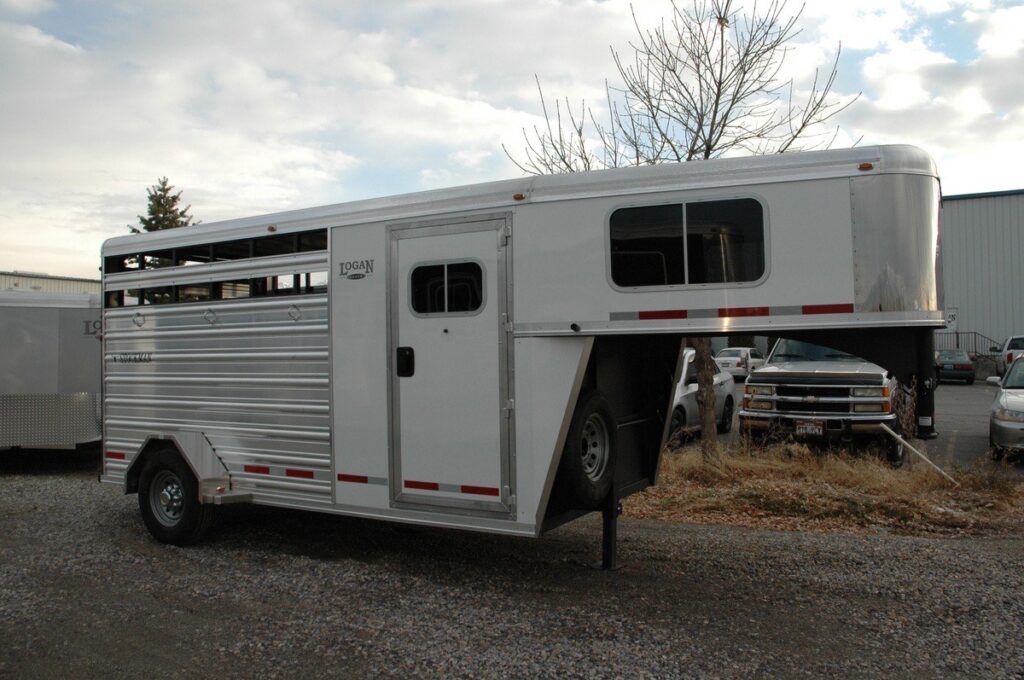
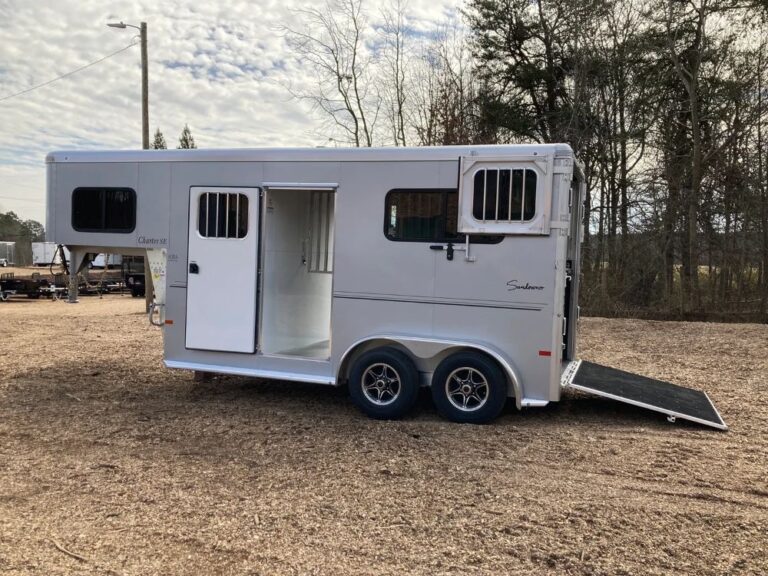
Some two-horse trailers have straight-load arrangements, while others use slant-load configurations.
The best layout depends on the horses, the manufacturer’s design, and your loading preferences.
Who Should Consider a Two-Horse Trailer?
A two-horse trailer may be suitable if you:
- Regularly transport one or two horses.
- Own horses for recreational riding.
- Need a trailer for veterinary appointments.
- Participate in local equestrian events.
- Have a compatible tow vehicle.
If you occasionally transport more horses than the trailer is designed for, do not exceed its capacity. Choose a configuration specifically rated for your intended use.
4. Three-Horse Trailer Sizes
Three-horse trailers provide additional capacity for owners who need to transport several horses.
They may suit equestrian businesses, training operations, and owners who regularly travel with multiple horses.
Depending on the model, a three-horse trailer may use a slant-load or another specialized interior arrangement.
Important Features to Compare
Feature | Why It Matters |
|---|---|
Stall dimensions | Each horse needs appropriate space |
Interior height | Must accommodate the horses comfortably |
Overall length | Affects maneuverability and storage |
Empty weight | Helps determine towing requirements |
GVWR | Establishes the manufacturer’s maximum loaded trailer weight |
Payload capacity | Determines the available capacity for horses and equipment |
Hitch configuration | Must match the tow vehicle |
Brakes and tires | Must be appropriate for the loaded trailer |
A three-horse trailer is not automatically suitable for every three-horse load.
Consider the size and combined weight of the horses, any equipment being carried, and the manufacturer’s capacity specifications.
5. Four-Horse and Larger Trailers
Larger horse trailers may be useful for professional riders, equestrian businesses, and owners who transport several horses regularly.
They can provide greater carrying capacity, but they also require more attention to towing compatibility and operating costs.
What to Consider
Before purchasing a larger trailer, evaluate:
- Overall length and width
- Interior layout
- Individual stall dimensions
- Empty weight
- GVWR
- Payload capacity
- Axle and tire ratings
- Braking system
- Tow vehicle capacity
- Parking and storage space
Larger trailers can be more difficult to maneuver in tight spaces and may require a more capable tow vehicle.
Some models include additional storage or living quarters, which can increase weight and cost.
Choose a larger trailer only when the additional space and features genuinely support your requirements.
6. Horse Trailer Interior Dimensions
The advertised number of horses is not enough to determine whether a trailer is suitable.
You should examine its actual interior measurements.
Interior Height
Interior height is particularly important for taller horses.
The horse should have appropriate headroom within the trailer’s intended configuration.
Interior Width
Interior width influences the space available to each horse and the layout of the stalls or partitions.
Stall Length
Stall length determines how much longitudinal space is available to each horse.
The appropriate dimensions depend on the horse’s size and the manufacturer’s design.
Door Opening
The entrance must be large enough for the horse to enter and exit safely.
Check the opening dimensions rather than relying only on the trailer’s overall width and height.
Ramp Dimensions
If the trailer uses a ramp, confirm that its width, angle, traction, and construction are appropriate for the intended horses.
Overall dimensions matter for towing, maneuvering, parking, and storage.
Remember that the external dimensions can be significantly different from the usable interior dimensions.
7. How to Measure Your Horse Before Buying
Measuring your horse can help you compare available trailers more accurately.
Consider the following:
- Height: Determine the horse’s height and compare it with the manufacturer’s interior-height recommendations.
- Body size: Consider the horse’s overall build, not just its height.
- Length: Evaluate whether the available stall space is appropriate.
- Behavior: Consider whether the horse needs a particular loading arrangement or partition configuration.
- Transportation requirements: Account for the expected journey and the horse’s individual needs.
If you’re transporting multiple horses, evaluate each horse rather than assuming one set of measurements will suit all of them.
For horses with special transportation requirements, consult a qualified equine professional or veterinarian.
8. Gooseneck vs. Bumper-Pull Horse Trailer Sizes
Horse trailers are available with different hitch configurations, and these can influence which sizes are practical for your setup.
Bumper-Pull Horse Trailers
Bumper-pull trailers connect to a compatible receiver hitch.
They can be suitable for smaller trailer configurations when the tow vehicle, hitch, and trailer ratings are appropriate.
Advantages may include not needing a gooseneck hitch installed in a pickup bed.
Gooseneck Horse Trailers
Gooseneck trailers connect to a specialized hitch installed in the bed of a compatible pickup truck.
They are commonly available in larger configurations, including many multi-horse models.
However, the pickup must have adequate towing and payload capacity, and the hitch must be properly installed and rated.
Comparison
Consideration | Bumper-Pull | Gooseneck |
|---|---|---|
Hitch location | Receiver hitch | Pickup bed |
Common applications | Many smaller configurations | Many larger configurations |
Tow vehicle | Must have suitable receiver-hitch capacity | Generally requires a compatible pickup |
Trailer size | Depends on ratings and design | Depends on ratings and design |
Maneuverability | Depends on setup | Depends on setup |
Main priority | Overall compatibility | Overall compatibility |
Neither configuration should be selected based on size alone.
For a more detailed comparison, see our planned supporting article on Gooseneck vs. Bumper-Pull Horse Trailers once it has been published.
9. Horse Trailer Weight Capacity
A trailer can have adequate physical space and still be unsuitable for the horses you want to transport.
Weight ratings are essential.
Understanding GVWR
Gross Vehicle Weight Rating (GVWR) is the maximum loaded trailer weight specified by the manufacturer.
Understanding Payload Capacity
Payload capacity is the amount of additional weight the trailer can carry after accounting for its empty weight.
The basic formula is:
Payload capacity = GVWR − empty trailer weight
Example
Suppose a horse trailer has the following specifications:
Specification | Example |
|---|---|
GVWR | 7,000 lb |
Empty trailer weight | 3,000 lb |
Nominal payload capacity | 4,000 lb |
The trailer’s nominal payload capacity is 4,000 pounds.
That capacity must account for the horses and any equipment or cargo carried in the trailer.
You must also confirm the tow vehicle’s maximum trailer weight, payload capacity, hitch rating, and other applicable limits.
For additional guidance, refer to our Horse and Stock Trailer Buying Guide: How to Choose the Right Trailer for Safe Livestock Transport.
10. How Your Tow Vehicle Affects Trailer Size
The trailer you choose must be compatible with your tow vehicle.
A trailer’s size and horse capacity are not the only factors that determine whether it can be towed safely.
Before purchasing, check:
- Maximum trailer weight
- Vehicle payload capacity
- Maximum tongue weight
- Hitch rating
- Gross combined weight rating, where applicable
- Tire and axle ratings
- Required towing equipment
The loaded trailer weight must remain within all relevant limits.
Why Tongue Weight Matters
Tongue weight is the downward force the trailer applies to the hitch.
A trailer that is too heavy or improperly loaded can exceed the tow vehicle’s or hitch’s limits and may affect towing stability.
Distribute the load according to the trailer manufacturer’s instructions, and do not exceed the rated capacity of any component.
Don’t Forget Maneuverability
Longer trailers can require more room to turn, reverse, park, and store.
Consider where you’ll use the trailer, including farm entrances, stables, event facilities, and storage areas.
The best size should be practical for both transportation and everyday handling.
11. Choosing the Right Horse Trailer Size for Your Needs
Your ideal trailer size depends on how you plan to use it.
For Individual Horse Owners
A smaller configuration may be appropriate if you transport one or two horses and have a compatible tow vehicle.
Focus on suitable stall dimensions, secure loading, and practical storage.
For Equestrian Businesses
Businesses transporting multiple horses may need additional capacity and a layout that supports their routine operations.
Consider how often you’ll travel, the size of the horses, and the equipment you need to carry.
For Competition and Long-Distance Travel
For frequent travel, prioritize the trailer’s overall condition, ventilation, loading arrangements, reliability, and towing compatibility.
Additional storage may be useful, but any extra equipment increases weight.
For Occasional Transportation
If you transport horses only occasionally, consider whether purchasing a trailer is more practical than hiring a suitable transporter.
If you decide to buy, choose a trailer that meets your actual requirements without unnecessary size or cost.
12. Common Horse Trailer Sizing Mistakes
Choosing Based Only on Horse Capacity
Two trailers advertised for the same number of horses may have different interior dimensions.
Always compare actual measurements.
Ignoring Horse Height
A trailer must provide appropriate headroom for the horses being transported.
Overlooking Payload
The trailer must carry the combined weight of the horses and equipment within its ratings.
Buying a Trailer Too Large for the Tow Vehicle
A trailer that exceeds your vehicle’s ratings is not an appropriate choice, regardless of its interior space.
Forgetting the Door Opening
The horses must be able to enter and exit safely through the available entrance.
Ignoring Storage and Parking
A trailer that is difficult to park or maneuver may create practical problems even if it has suitable interior dimensions.
Choosing Based Only on Price
A low-priced trailer may not have the necessary dimensions, capacity, or features.
Compare specifications and condition before making your decision.
13. Horse Trailer Size Buying Checklist
Use this checklist when comparing models.
Requirement | What to Verify |
|---|---|
Horse capacity | Appropriate for the number of horses |
Interior height | Suitable for the horses |
Interior width | Adequate usable space |
Stall length | Suitable for each horse |
Door opening | Safe entry and exit |
Loading arrangement | Suitable ramp or step-up configuration |
Empty weight | Confirmed from specifications |
GVWR | Appropriate for the intended load |
Payload | Enough capacity for horses and equipment |
Tow vehicle | Compatible with the loaded trailer |
Hitch | Correct type and rating |
Tires and brakes | Suitable for the loaded trailer |
Overall dimensions | Practical for roads, storage, and maneuvering |
Condition | Carefully inspected, particularly for used models |
Taking time to compare these details can help you choose a trailer that meets your requirements.
Frequently Asked Questions
What size horse trailer do I need for two horses?
You need a trailer specifically designed for two horses with suitable stall dimensions, interior height, and weight capacity. The right model depends on the horses’ sizes and the manufacturer’s specifications.
Are all two-horse trailers the same size?
No. Interior dimensions, overall length, stall layout, and weight ratings vary by manufacturer and model.
Is a larger horse trailer always better?
No. A larger trailer may provide additional space, but it can also cost more, weigh more, and be more difficult to tow and store.
Does trailer size affect towing requirements?
Yes. Larger trailers are often heavier and may place greater demands on the tow vehicle and hitch. Always verify the complete towing setup’s ratings.
Should I choose a gooseneck or bumper-pull trailer?
The choice depends on the trailer’s size and weight, the tow vehicle, the hitch, and your intended use. Confirm compatibility before purchasing.
What should I check when buying a used horse trailer?
Inspect the floor, frame, tires, brakes, axles, suspension, doors, partitions, and ventilation. Check the trailer’s weight ratings and consider a professional inspection.
Final Thoughts
Choosing the right horse trailer size requires more than counting how many horses a model can accommodate.
You need to evaluate the horses’ dimensions, the available interior space, loading arrangements, trailer weight, payload capacity, and towing compatibility.
A smaller trailer may be ideal for an individual owner, while an equestrian business transporting several horses may need a larger configuration. Neither option is automatically better; the right choice depends on your actual requirements.
Before making your final decision, compare the manufacturer’s specifications carefully and ensure the trailer is appropriate for your horses and towing vehicle.
For broader buying guidance, read our Horse and Stock Trailer Buying Guide: How to Choose the Right Trailer for Safe Livestock Transport and explore the Horse & Stock Trailers product category.
The right horse trailer should provide suitable space for your horses, appropriate safety features, and a towing setup that works safely for your needs.
For open-deck equipment hauling, Utility Trailers provide a different configuration. For wide equipment, Deck-Over Trailers may be worth considering. And for horses or livestock, Horse & Stock Trailers are designed specifically for that type of transportation.
For safe towing and loading practices, visit the NHTSA trailer safety guidelines.
