

Table of Contents
ToggleWhat Is a Horse and Stock Trailer? A Complete Guide for Buyers
Horse and stock trailers are essential for horse owners, ranchers, farmers, livestock businesses, and anyone who needs to transport animals safely from one location to another.
Although horse trailers and stock trailers serve similar purposes, they are designed with different transportation needs in mind. Horse trailers often prioritize individual animal compartments, interior comfort, and specialized loading arrangements. Stock trailers are generally designed to transport livestock, such as cattle, sheep, and goats, with an emphasis on ventilation, durability, and practical loading.
Choosing the right trailer depends on the animals you transport, the number of animals, the distance you travel, and the conditions in which the trailer will be used.
For example, a horse owner traveling to equestrian competitions may need a trailer with individual stalls and specialized horse-loading features. A rancher transporting cattle may prefer a stock trailer with a practical interior layout, secure gates, and appropriate ventilation.
The best trailer is one that accommodates your animals safely, matches your towing vehicle, and meets your transportation requirements.
If you’re considering purchasing one, start with our Horse and Stock Trailer Buying Guide: How to Choose the Right Trailer for Safe Livestock Transport. This pillar guide explains the main factors to consider before buying.
In this article, we’ll explore the differences between horse and stock trailers, their common applications, the features buyers should evaluate, and how to select the right configuration.
1. What Is a Horse Trailer?
A horse trailer is a specialized trailer designed to transport horses between locations.
Horse trailers are commonly used by individual horse owners, riding schools, equestrian businesses, ranchers, and professional riders.
Depending on the model, a horse trailer may include individual stalls, partitions, ventilation openings, padded interior surfaces, specialized flooring, and a ramp or step-up entrance.
Some models also provide tack storage for saddles, bridles, and other riding equipment.
Common Uses for Horse Trailers
Horse trailers can be used for:
- Transporting horses between farms and stables.
- Traveling to equestrian competitions.
- Taking horses to veterinary appointments.
- Moving horses between properties.
- Transporting horses to training facilities.
- Traveling to recreational riding locations.
- Supporting professional equestrian operations.
The right trailer should provide adequate interior space, appropriate ventilation, reliable flooring, and a suitable loading arrangement.
It must also be compatible with the tow vehicle and remain within the manufacturer’s weight ratings.
Important Horse Trailer Features
When evaluating a horse trailer, consider:
- Interior height and width.
- Stall dimensions.
- Secure partitions.
- Door and latch quality.
- Ventilation.
- Flooring condition.
- Ramp or step-up design.
- Tire and axle ratings.
- Braking equipment.
- Overall construction quality.
These features contribute to the trailer’s suitability for the horses you intend to transport.
If you are ready to compare available models, explore our Horse & Stock Trailers product category.
2. What Is a Stock Trailer?
A stock trailer is designed primarily for transporting livestock.
Common animals transported in stock trailers include cattle, sheep, goats, and other livestock suitable for the trailer’s design.
Stock trailers are commonly used by farmers, ranchers, livestock producers, and agricultural businesses.
Unlike many horse trailers, which may have individual stalls or partitions, stock trailers often have an open interior designed to accommodate groups of animals.
However, configurations vary. Some stock trailers include dividers or compartments to separate animals when necessary.
Common Uses for Stock Trailers
Stock trailers are frequently used for:
- Transporting cattle between farms.
- Moving livestock to markets.
- Taking animals to agricultural shows.
- Transporting sheep and goats.
- Moving animals between grazing areas.
- Supporting ranching operations.
- Transporting livestock to veterinary facilities.
The trailer must be appropriate for the species, number, size, and condition of the animals being transported.
Important Stock Trailer Features
Buyers should consider:
- Appropriate interior space.
- Adequate ventilation.
- Secure gates and latches.
- Suitable flooring and traction.
- Durable construction.
- Safe loading and unloading access.
- Appropriate axle and tire ratings.
- Easy-to-clean interior surfaces.
A stock trailer should be selected according to the livestock being transported, not simply the number of animals that can physically fit inside.
For buyers comparing different configurations, our Horse & Stock Trailers category is the natural starting point for exploring relevant trailer options.
3. Horse Trailer vs. Stock Trailer: What’s the Difference?
Although both trailers transport animals, their interior layouts and intended applications can differ considerably.
A horse trailer is generally designed around the requirements of transporting horses, while a stock trailer is typically designed for livestock transportation.
Feature | Horse Trailer | Stock Trailer |
|---|---|---|
Primary purpose | Transporting horses | Transporting livestock |
Typical animals | Horses and ponies | Cattle, sheep, goats, and other suitable livestock |
Interior arrangement | Often includes individual stalls or partitions | Often has an open interior, sometimes with dividers |
Ventilation | Designed for the horses being transported | Designed for the livestock being transported |
Flooring | Must provide appropriate support and traction for horses | Must provide appropriate support and traction for livestock |
Loading arrangement | Ramp or step-up, depending on model | Rear gates, ramps, or other suitable entrances |
Common buyers | Horse owners and equestrian businesses | Farmers, ranchers, and livestock operators |
Interior accessories | May include tack storage | May include livestock dividers and practical storage |
Cleaning requirements | Must be suitable for horse waste and routine cleaning | Must be suitable for livestock waste and routine cleaning |
These are general distinctions rather than absolute rules. Some trailers can accommodate multiple types of animals when specifically designed and configured for that purpose.
Which One Should You Choose?
Choose a horse trailer if your primary requirement is transporting horses and you need a configuration suited to their size, behavior, and transportation needs.
Choose a stock trailer if you primarily transport livestock and need an appropriate arrangement for those animals.
If you transport different species, confirm that the trailer’s design and configuration are suitable for every intended use.
4. What Are Horse Trailers Used For?
Horse trailers serve a wide range of personal, recreational, and commercial purposes.
Personal Horse Transportation
Individual horse owners often need trailers for trips to veterinary appointments, riding locations, or other stables.
A smaller trailer may be suitable if it provides adequate space for the horse and can be towed safely by the owner’s vehicle.
Equestrian Competitions
Riders who participate in competitions may require a trailer that can transport horses and, depending on the configuration, riding equipment.
Interior dimensions, secure partitions, ventilation, and convenient access are particularly important.
Horse Training Businesses
Training facilities may transport horses between stables, training locations, and events.
A suitable trailer can make these trips more convenient, provided it accommodates the horses and the business’s operating requirements.
Commercial Horse Transportation
Businesses transporting horses professionally may need to consider durability, maintenance, loading efficiency, and the suitability of the trailer for repeated journeys.
The best configuration depends on the number of horses, the routes traveled, and the transportation conditions.
5. What Are Stock Trailers Used For?
Stock trailers are particularly useful for agricultural and livestock operations.
Cattle Transportation
Farmers and ranchers may use stock trailers to move cattle between properties, grazing areas, markets, and other agricultural facilities.
The trailer must provide appropriate space, ventilation, and secure containment.
Sheep and Goat Transportation
Stock trailers may also be configured for transporting sheep and goats.
Because these animals differ in size and behavior from cattle, the interior arrangement and loading setup should be appropriate for the species being transported.
Agricultural Businesses
Livestock producers may need trailers for routine farm operations, animal sales, agricultural shows, and veterinary visits.
A trailer that is easy to clean and maintain can be especially useful for frequent livestock transportation.
Important Consideration
Different species have different transportation requirements. Avoid overcrowding and follow applicable animal welfare and transportation requirements.
The number of animals a trailer can carry safely depends on their size, weight, condition, available space, and the trailer’s design.
6. Different Types of Horse Trailers
Horse trailers are available in several configurations.
Understanding these designs can help buyers narrow their options.
Bumper-Pull Horse Trailers
Bumper-pull trailers connect to a compatible receiver hitch on the tow vehicle.
They may be suitable for individual owners and smaller equestrian operations, depending on the trailer’s weight and capacity.
Before purchasing, confirm that the tow vehicle and hitch can handle the loaded trailer.
Gooseneck Horse Trailers
Gooseneck trailers connect to a specialized hitch generally installed in the bed of a compatible pickup truck.
They are commonly available in larger configurations, including models designed for multiple horses.
Their suitability depends on the trailer’s specifications and the pickup’s towing and payload ratings.
Straight-Load Horse Trailers
In a straight-load configuration, horses generally face forward in individual spaces.
The suitability of this arrangement depends on the horse, the trailer’s design, and the owner’s transportation requirements.
Slant-Load Horse Trailers
Slant-load trailers position horses at an angle to the direction of travel.
This configuration is used in some multi-horse trailers.
The correct arrangement depends on the individual horses, interior dimensions, and manufacturer specifications.
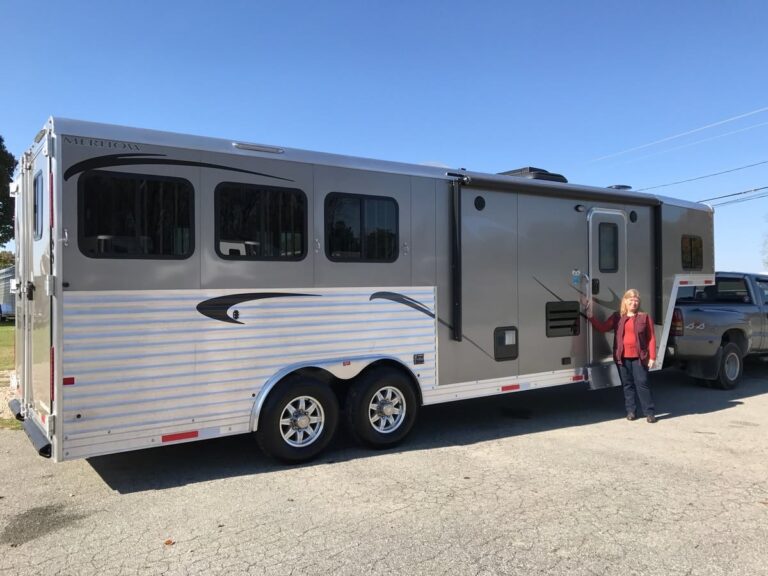
Horse Trailers With Living Quarters
Some horse trailers incorporate living or resting areas.
These models may appeal to people who travel regularly to competitions or equestrian events.
However, living quarters add weight and cost, so buyers must consider their actual needs and the complete towing setup.
When comparing configurations, begin with our Horse & Stock Trailers category and evaluate each model according to its specifications and intended use.
7. Different Types of Stock Trailers
Stock trailers also come in different configurations.
Bumper-Pull Stock Trailers
These trailers connect to a compatible receiver hitch.
They may suit smaller livestock operations, provided their capacity and configuration meet the requirements of the animals being transported.
Gooseneck Stock Trailers
Gooseneck stock trailers connect to a specialized hitch in a compatible pickup truck.
They are available in a range of sizes and capacities for different livestock transportation applications.
Open Stock Trailers
Open stock trailers have an open or partially open design that allows airflow through the trailer.
The specific construction and ventilation arrangement vary by model.
Enclosed or Covered Stock Trailers
Some stock trailers incorporate additional overhead or side protection.
The appropriate configuration depends on the animals, climate, journey, and intended use.
Regardless of design, ensure the trailer provides appropriate ventilation and does not expose animals to avoidable hazards.
8. Choosing the Right Trailer Size
Trailer size should be determined by the animals you transport and the amount of space they require.
Choosing a trailer solely by its advertised animal capacity can lead to problems if the animals are larger than expected or if the interior dimensions are unsuitable.
Before buying, review the manufacturer’s measurements and compare them with the requirements of your animals.
Key Measurements to Check
Measurement | Why It Matters |
|---|---|
Interior length | Determines available space for the animals |
Interior width | Helps establish whether animals can be accommodated appropriately |
Interior height | Important for horses and other taller animals |
Door opening | Determines whether animals can enter and exit safely |
Stall or compartment dimensions | Important when individual spaces are provided |
Overall trailer width | Affects towing and road clearance |
Overall trailer length | Affects maneuverability and storage |
Should You Buy a Larger Trailer?
A larger trailer may provide additional flexibility, but it can also increase purchase costs, weight, and towing requirements.
The right size should accommodate your animals appropriately without exceeding your tow vehicle’s capabilities.
If you regularly transport different numbers or sizes of animals, discuss the intended use with the trailer manufacturer or a qualified livestock transportation professional before choosing a configuration.
9. Understanding Trailer Weight Capacity
Weight capacity is just as important as physical dimensions.
A trailer may have enough room for the animals but still be unsuitable for their combined weight.
Two important terms are GVWR and payload capacity.
Gross Vehicle Weight Rating (GVWR) is the maximum loaded trailer weight specified by the manufacturer.
Payload capacity is the amount of additional weight the trailer can carry after accounting for its empty weight.
The basic calculation is:
Payload capacity = GVWR − empty trailer weight
Example of Trailer Payload
Suppose a trailer has the following specifications:
Specification | Example |
|---|---|
GVWR | 7,000 lb |
Empty trailer weight | 3,000 lb |
Nominal payload capacity | 4,000 lb |
In this example, the trailer has a nominal payload capacity of 4,000 pounds.
The payload must account for the combined weight of the animals and any additional equipment or cargo.
You must also confirm the towing vehicle’s capacity, hitch rating, axle ratings, and tire load ratings.
Never exceed the trailer’s GVWR or the limits of any component in the towing setup.
10. Essential Safety Features
Safety is one of the most important considerations when buying a horse or stock trailer.
Animals can move unexpectedly during transportation, so the trailer must be suitable for their size, behavior, and transportation needs.
Secure Doors and Latches
Doors and gates should operate smoothly and close securely.
Inspect the hinges, latches, locking mechanisms, and other hardware for damage or excessive wear.
Appropriate Flooring
The floor should provide adequate support and traction.
Inspect for rot, cracks, corrosion, damaged boards, and other signs of deterioration.
Suitable Partitions
Where partitions are provided, they should be appropriate for the trailer’s intended animals and configuration.
They must be securely installed and free from hazardous edges or damaged components.
Brakes and Tires
The tires, brakes, axles, and suspension must be suitable for the trailer’s loaded weight.
Inspect them regularly and follow the manufacturer’s maintenance recommendations.
Secure Hitch Connection
The coupler, hitch, safety chains, and other connection components must be appropriate for the towing setup.
Check the connection before every journey.
Safe Loading Access
Ramps, gates, and entrances should be appropriate for the animals and the handlers.
The loading area should be stable and free from obvious hazards.
11. Ventilation and Animal Comfort
Ventilation is especially important when transporting live animals.
A suitable trailer should provide airflow appropriate to the species, number of animals, weather conditions, and journey.
When evaluating a trailer, inspect:
- Ventilation openings
- Windows and vents
- Roof ventilation, where fitted
- Airflow through the animal compartment
- Vent covers and mechanisms
- Interior surfaces
- The condition of partitions
Do not assume that more openings automatically make a trailer suitable.
The overall ventilation design must work for the animals being transported and the conditions in which the trailer will be used.
Preventing Overcrowding
Overcrowding can compromise animal comfort and safety.
The number of animals transported should reflect their size, available space, behavior, journey duration, and applicable transportation requirements.
Always follow relevant animal welfare guidance and seek professional advice when necessary.
12. Loading and Unloading Options
Horse and stock trailers use different loading arrangements depending on their design.
Common options include ramps, step-up entrances, and rear gates.
Ramp Loading
Ramps can make it easier for some animals to enter a trailer, provided the ramp is suitable for the animal and the loading conditions.
Check the ramp’s:
- Width
- Surface traction
- Angle
- Structural condition
- Hinges and supports
- Latching mechanism
Step-Up Entrances
Some trailers are designed for animals to step into the trailer.
Whether this is suitable depends on the animal’s size, behavior, mobility, and experience.
Rear Gates and Dividers
Stock trailers may include rear gates and internal dividers to help manage animal movement.
Inspect all moving components to ensure they operate properly and remain securely closed during transportation.
The right loading system is one that suits the animals being transported and allows safe, controlled loading and unloading.
13. Steel vs. Aluminum Horse and Stock Trailers
Construction materials can influence trailer weight, corrosion resistance, maintenance, and purchase price.
Steel Trailers
Steel trailers can offer durable construction when properly designed and maintained.
However, exposed steel and damaged protective coatings can be vulnerable to corrosion.
Regular inspections help identify rust and structural deterioration.
Aluminum Trailers
Aluminum trailers are often selected because of their lower weight in some designs and their resistance to many forms of corrosion.
However, construction quality and maintenance remain important.
Comparison Table
Factor | Steel Trailer | Aluminum Trailer |
|---|---|---|
Weight | Often heavier | Often lighter |
Corrosion resistance | Depends on coatings and maintenance | Generally more corrosion-resistant |
Maintenance | Inspect for rust and coating damage | Inspect joints, fasteners, and structural components |
Initial cost | Often lower | May be higher |
Suitability | Depends on design and intended use | Depends on design and intended use |
Don’t choose based on material alone.
Compare the specific trailer’s construction, weight ratings, maintenance needs, and intended application.
14. How to Choose the Right Horse or Stock Trailer
Before purchasing, consider the following questions.
What Animals Will You Transport?
Identify the species, size, number, and typical transportation requirements.
A trailer designed for horses should not automatically be assumed suitable for transporting cattle or other livestock.
How Often Will You Use It?
Frequent commercial use may justify investing in a durable configuration designed for repeated transportation.
Occasional use may require a different balance between price and features.
What Is Your Budget?
Consider the purchase price as well as maintenance, tires, brakes, storage, and other operating expenses.
What Vehicle Will Tow It?
Confirm that your tow vehicle can safely handle the trailer’s loaded weight and hitch requirements.
Do You Need Additional Storage?
Tack storage, equipment compartments, and other accessories can be useful, but they may increase weight and cost.
Will You Transport Different Types of Animals?
If so, confirm that the trailer’s construction and configuration are appropriate for every intended use.
For a more comprehensive purchasing overview, return to our Horse and Stock Trailer Buying Guide: How to Choose the Right Trailer for Safe Livestock Transport.
You can also browse our Horse & Stock Trailers category to explore the product options available.
15. Common Buying Mistakes to Avoid
Choosing Based Only on Price
A cheaper trailer may have insufficient capacity, unsuitable dimensions, or expensive maintenance requirements.
Compare the complete specifications and condition.
Ignoring Animal Size
A trailer may advertise capacity for several animals without being appropriate for every animal of that species or size.
Verify the actual interior dimensions and manufacturer’s recommendations.
Overlooking Weight Ratings
Always consider the animals’ combined weight, equipment, and the trailer’s empty weight.
Stay within all applicable ratings.
Neglecting Ventilation
Ventilation is essential when transporting live animals.
Check that the trailer’s design is appropriate for the animals and intended journeys.
Buying Without Inspecting the Floor
Floor deterioration can be a serious concern.
Inspect the floor carefully, especially when purchasing a used trailer.
Forgetting Towing Compatibility
The tow vehicle, hitch, tires, brakes, and other components must be suitable for the complete loaded trailer.
Failing to Check Maintenance History
For used trailers, ask about maintenance and inspect the major components before purchasing.
A professional inspection can help identify problems that aren’t immediately obvious.
16. Horse and Stock Trailer Buying Checklist
Use this checklist when comparing models.
Item | What to Verify |
|---|---|
Intended animals | Trailer is designed for the animals being transported |
Animal capacity | Appropriate for the number and size of animals |
Interior dimensions | Adequate space and headroom |
Ventilation | Suitable for intended use |
Flooring | Safe, suitable, and in good condition |
Partitions | Appropriate and securely installed |
Doors and gates | Operate and latch properly |
Loading arrangement | Suitable for the animals |
GVWR | Appropriate for the loaded trailer |
Payload | Sufficient for animals and equipment |
Tires and brakes | Correct ratings and good condition |
Hitch | Compatible with the tow vehicle |
Frame and axles | No significant damage |
Maintenance history | Reviewed, especially for used trailers |
Total cost | Purchase and operating costs considered |
Taking time to review these details can help you avoid purchasing a trailer that doesn’t meet your needs.
Frequently Asked Questions
What is the difference between a horse trailer and a stock trailer?
A horse trailer is specifically designed for transporting horses and often includes specialized stalls or partitions. A stock trailer is generally designed for livestock transportation and often has an open interior. Actual configurations vary by model.
Can you use a stock trailer to transport horses?
Some stock trailers may be suitable for transporting horses if their design, dimensions, flooring, ventilation, partitions, and safety features meet the horses’ needs. Not every stock trailer is appropriate for horses, so verify suitability with the manufacturer.
What animals can a stock trailer carry?
Depending on its design, a stock trailer may transport cattle, sheep, goats, and other suitable livestock. The trailer’s configuration and ratings must be appropriate for the animals.
Are gooseneck trailers better than bumper-pull trailers?
Neither is automatically better. The correct option depends on the trailer’s weight, intended use, tow vehicle, hitch, and capacity requirements.
Is aluminum better than steel for animal trailers?
Aluminum is generally more corrosion-resistant and is often lighter, while steel may cost less initially. The better choice depends on the trailer’s design, construction quality, maintenance, and intended application.
What should I check before buying a used horse or stock trailer?
Inspect the flooring, frame, tires, brakes, axles, suspension, doors, gates, partitions, ventilation, and electrical components. Review the maintenance history and consider a professional inspection.
Final Thoughts
Horse and stock trailers play an important role in equestrian and agricultural transportation, but choosing the right model requires careful consideration.
A horse trailer is generally the right starting point for horse owners who need a configuration designed around the horses they transport. A stock trailer may be more suitable for farmers and ranchers who regularly move livestock.
Before making a purchase, compare the trailer’s dimensions, animal capacity, weight ratings, ventilation, flooring, loading arrangements, and towing requirements.
Don’t choose solely by appearance, advertised capacity, or purchase price. The trailer must be appropriate for the animals and safe for the conditions in which it will be used.
If you’re ready to explore your options, visit our Horse & Stock Trailers product category. For additional purchasing guidance, refer to our Horse and Stock Trailer Buying Guide: How to Choose the Right Trailer for Safe Livestock Transport.
Ultimately, the right trailer is one that accommodates your animals appropriately, provides suitable ventilation and secure transportation, and works safely with your towing vehicle.
For open-deck equipment hauling, Utility Trailers provide a different configuration. For wide equipment, Deck-Over Trailers may be worth considering. And for horses or livestock, Horse & Stock Trailers are designed specifically for that type of transportation.
For safe towing and loading practices, visit the NHTSA trailer safety guidelines.
